
 Unit21
 ComplyAdvantage
 Trulioo
 Alloy
 Persona
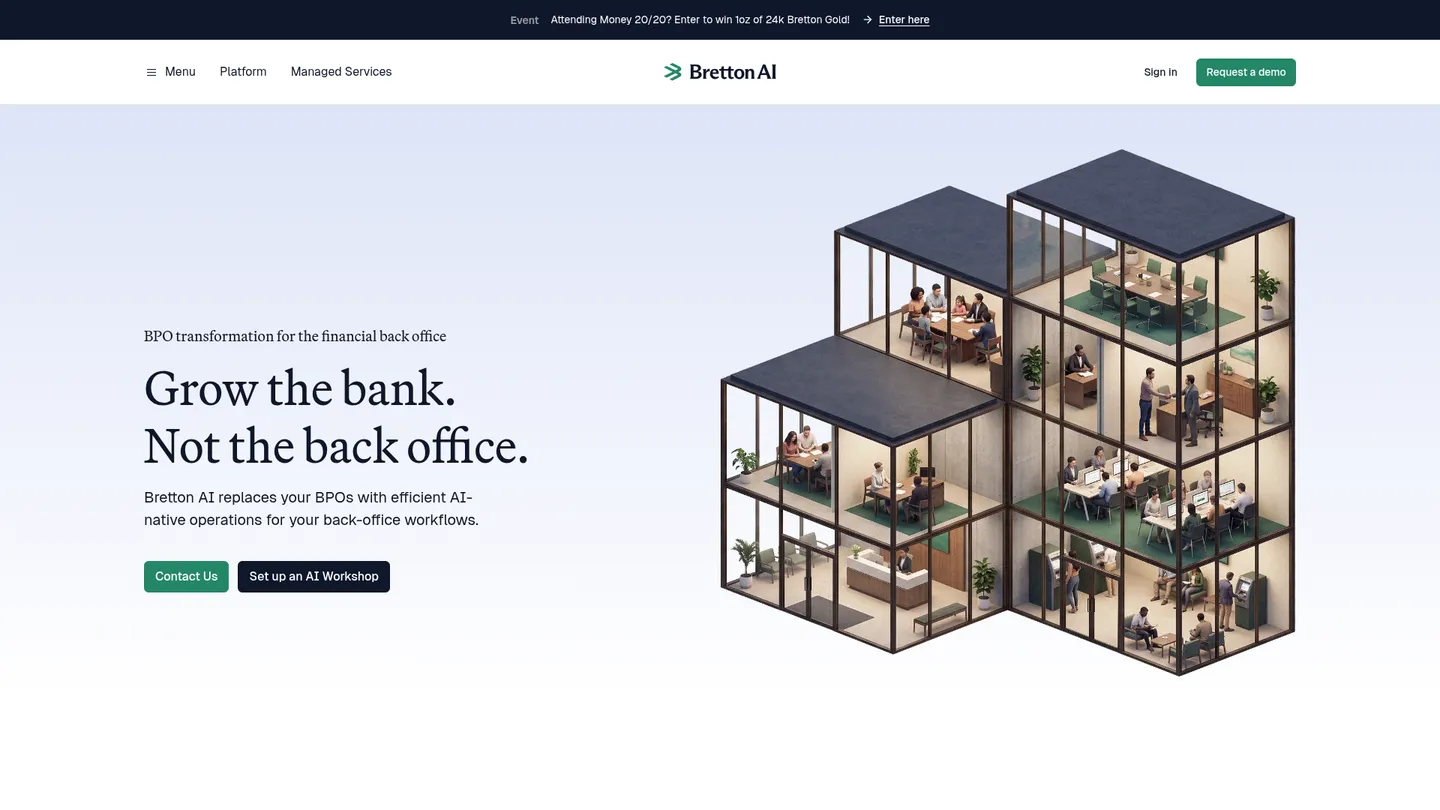
What is Bretton AI?
Founded in 2023 and headquartered in San Francisco, Greenlite rebranded to Bretton AI in February 2026. Its AI agents handle AML, KYC and financial-crime operations for regulated financial institutions.
Bretton AI overlays existing financial back-office systems, data and policies with AI agents for financial-crime operations. Pre-built templates support regulated workflows, while Builder creates custom agents in natural language. Workbench gives analysts a shared environment to review and act on cases alongside agents. Its Trust Infrastructure records reasoning, evidence and model versions, creating an auditable record of agent activity and human review.
The platform covers enhanced due diligence, KYB, KYC, sanctions and PEP screening, adverse media, transaction-monitoring alerts, document review, SAR drafting, periodic reviews and broader investigations. It supports L1 and L2 workflows, but it is an enterprise overlay and managed-services product rather than a self-serve GRC suite. Public materials do not show package pricing or a free trial. Analysts remain involved in reviewing and escalating cases.
Bretton targets regulated banks, fintechs, payments companies, exchanges and other financial institutions that need additional investigation capacity. It sells through enterprise contracts and also offers consumption-priced managed services. The company says a first workflow can go live in 60 days, while a Payward implementation used a two-to-three-week validation period before full integration. Buyers need to scope their workflows, existing systems and review requirements with the vendor.
Key features
Agent templates
Deploy 30+ pre-built skills and agents for EDD, monitoring, sanctions, SAR drafting, KYB, HMDA and CRA workflows.
Custom agent builder
Create agents in natural language using customer data, policies and analyst judgment.
Case workbench
Give analysts an AI companion to investigate, review and act on cases in a shared workspace.
Financial-crime investigations
Gather evidence, apply policy and draft L1 and L2 case narratives for human approval.
Trust infrastructure
Log actions with reasoning, evidence and model versions for auditability and evaluation.
Managed AML services
Pair the platform with onshore AML experts, consumption pricing and case quality control.
System integrations
Connect case-management, KYC/KYB, screening, core, warehouse, database, SFTP and browser-based systems.
Bretton AI pricing
Bretton publishes no self-serve price or paid entry tier. Its managed-services offering describes consumption pricing from day one and says the first workflow can be live in 60 days. Capterra lists the starting price and free trial as unavailable.
| Plan | Price | What's included |
|---|---|---|
| Enterprise | Custom | AI agent platform, workflow configuration, case investigations, deployment support |
Free trial: No public free trial; contact sales for an enterprise evaluation.
Pros & cons
Pros
- Automates investigation work beyond simple alert triage, including evidence gathering and narrative drafting.
- Every action, source and model version is logged for audit review.
- Works with existing systems and supports connectors, APIs, data warehouses, SFTP and browser workflows.
- Named case studies report 70% faster EDD at Grasshopper and 52,000 hours saved at Payward.
Cons
- Pricing is not published and requires a sales conversation.
- There is no public free trial or self-serve plan.
- Public independent review coverage is limited.
- The product focuses on financial-crime and regulated back-office workflows rather than broad all-purpose GRC.
Who is Bretton AI best for?
- Regulated banks scaling AML and KYC operations.
- Fintechs and payments firms with high-volume review queues.
- Compliance teams that need AI agents over existing systems rather than a rip-and-replace platform.
- Organizations willing to use an enterprise sales process and validate model performance in production.
Use cases
Integrations
Notable customers
Frequently asked questions
How much does Bretton AI cost?
+
Bretton does not publish package prices. The platform is sold through enterprise contracting, while managed services use consumption pricing from day one; buyers must request a quote.
How long does implementation take?
+
Bretton says managed-services customers can have a first workflow live in 60 days, with real cases in the first week. Payward’s case study describes a two-to-three-week quality-validation period before full integration.
How does Bretton compare with ComplyAdvantage or Unit21?
+
Bretton is positioned as an AI-agent and managed-operations layer that performs investigations inside existing systems. Unit21 and ComplyAdvantage are primarily monitoring, screening, case-management or data products.
Which integrations does it support?
+
Named integrations include Unit21, Sumsub, Persona, Google Drive and Databricks Delta Share. Bretton also supports warehouse and database access, APIs, SFTP, browser workflows and custom connectors.
Who is Bretton AI for?
+
It targets regulated banks, fintechs, payments companies, exchanges and other financial institutions with AML, KYC, KYB, EDD or alert-review workloads. Public case studies include Payward/Kraken, Grasshopper Bank, First Internet Bank and HitPay.
How does Bretton address security and accuracy?
+
The company states that its Trust Infrastructure provides audit logs, reasoning, evidence, model versions, independent model validation, zero-data retention, SOC 2 Type II, GDPR compliance and private-cloud deployment. Its managed-services offering says every case is reviewed against the customer’s quality-control scorecard.
Sources
Facts and pricing verified on October 19, 2026. Vendors change pricing often, so confirm with Bretton AI before buying. How we research