
 Alloy
 Unit21
 Sardine
 Hummingbird
 Feedzai
What is Finic?
Finic combines a real-time decision model with AI agents for financial-crime investigations. Its materials describe structured and unstructured analysis, calibrated outputs, workflow automation, and usage-based prepaid credits.
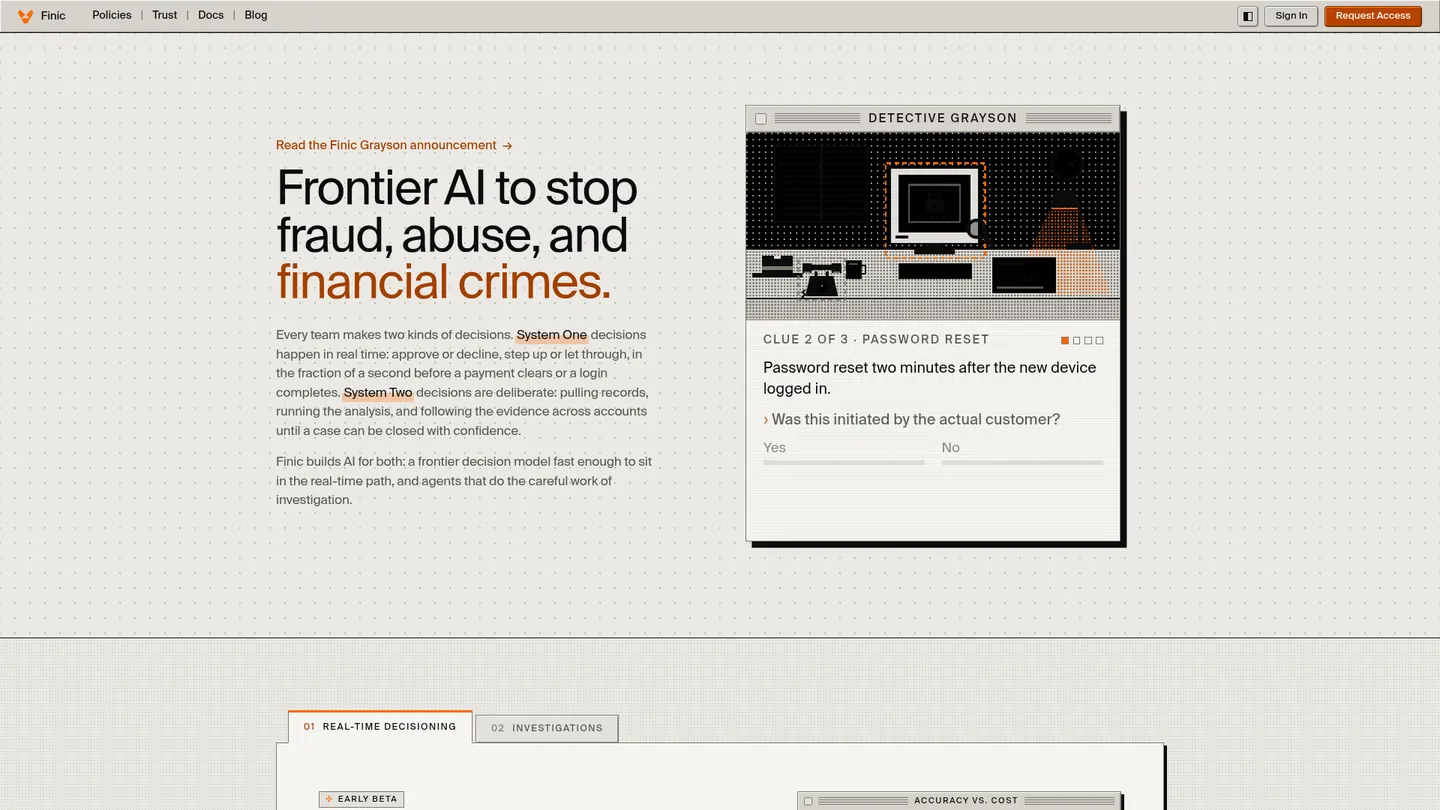
Finic is an AI platform for financial institutions that combines a real-time decision model with agents for deliberate investigations. Grayson accepts structured or unstructured context, including transactions, login events, case notes, and call transcripts, together with typed questions. It returns probabilities or classifications that can support decision engines, review queues, and analysts handling fraud, abuse, risk, compliance, and financial-crime work.
The platform addresses both rapid and investigative workflows. Public materials describe decisions such as approval, decline, step-up, or allow, alongside agents that retrieve records, analyze evidence across accounts, follow investigation procedures, and document actions. Grayson supports yes-or-no, multiple-choice, and scoring questions, with calibrated outputs intended to help teams set thresholds and route uncertain cases for review. The decision model and the investigation agents serve different stages of a risk workflow: one supplies classifications, while the other gathers and evaluates evidence for review.
Finic provides access through its API and portal using prepaid usage credit. The homepage advertises 0.01¢ per decision, while the master services agreement states that successful API and playground requests draw down credit at rates shown in the portal. Public materials also describe introductory credit, zero data retention by default, and gradual access during an early-beta rollout. This makes request volume and the split between automated decisions and investigated cases important buying considerations.
Key features
Real-time risk decisions
Grayson evaluates context and typed questions for decisions such as approve, decline, step up, or allow.
Fraud and abuse detection
The decision model is positioned for fraud, abuse, account takeover, and related risk questions.
Financial-crime investigations
Investigation agents retrieve records, analyze evidence, follow procedures, and support case resolution.
Universal decision questions
Teams can submit yes-or-no, multiple-choice, or scoring questions without retraining when questions or data change.
Structured and unstructured analysis
Inputs can include transactions, login activity, case notes, support tickets, adverse media, and transcripts.
Calibrated outputs
Probability outputs are designed to support thresholds, automated routing, and review of borderline decisions.
Investigation audit trails
Agent workflows document investigation steps, data sources, conclusions, and subsequent actions.
Finic pricing
Customers prepay credit, and successful API or playground requests draw down the balance at portal rates. The homepage advertises 0.01¢ per decision; no public subscription tiers were verified.
| Plan | Price | What's included |
|---|---|---|
| Free credit | Free | Introductory credit for a new organization |
| Usage | Usage-based | API and playground requests charged against prepaid credit |
| Enterprise | Custom | Order-specific commercial terms |
Free trial: New organizations receive free credit in the amount shown in the portal.
Pros & cons
Pros
- Combines real-time decisioning with investigation automation.
- Supports multiple question types without repeated model retraining.
- Calibrated probabilities can support threshold-based routing.
- Usage-based pricing may suit high-volume decision workloads.
Cons
- Public materials do not provide a complete pricing rate card.
- Named external software integrations are not publicly listed.
- Consequential decisions still require governance and human review.
- Access is described as gradual during an early-beta rollout.
Who is Finic best for?
- Fraud and risk teams at fintechs, banks, lenders, and marketplaces.
- Organizations analyzing structured and unstructured risk data.
- Fraud operations teams constrained by manual investigation capacity.
- Engineering teams adding model-based decisions to existing review workflows.
Use cases and capabilities
Integrations
Frequently asked questions
How is Finic priced?
+
Finic uses prepaid usage credit rather than published subscription tiers. The homepage advertises 0.01¢ per decision, while the master services agreement says requests are charged at rates shown in the portal.
How does Finic work in production?
+
Applications send context and typed questions to Grayson through the API. Results can then support a rules engine, router, or review queue, while investigation agents perform multi-step evidence work.
What types of questions can Grayson answer?
+
Grayson supports yes-or-no, multiple-choice, and scoring questions. Its public examples cover fraud, account takeover, login activity, loan applications, and other risk decisions.
What integrations does Finic support?
+
The documented product interface includes the Grayson API and Finic portal. Public materials do not name external warehouse, case-management, or data-provider integrations.
Who is Finic for?
+
Finic targets fraud, risk, trust-and-safety, compliance, and financial-crime teams at financial institutions. It is most relevant where high event volume or manual investigation limits operational capacity.
Does Finic provide security and data-retention controls?
+
The security center lists SOC 2 Type 2 compliance and ISO 27001 certification for Finic. Its agreement describes configurable retention, including zero data retention by default, and states that customer data is not used to train models.
Sources
Facts and pricing verified on October 19, 2026. Vendors change pricing often, so confirm with Finic before buying. How we research