
 TaxJar
 Avalara
 Anrok
 Stripe Tax
 Vertex
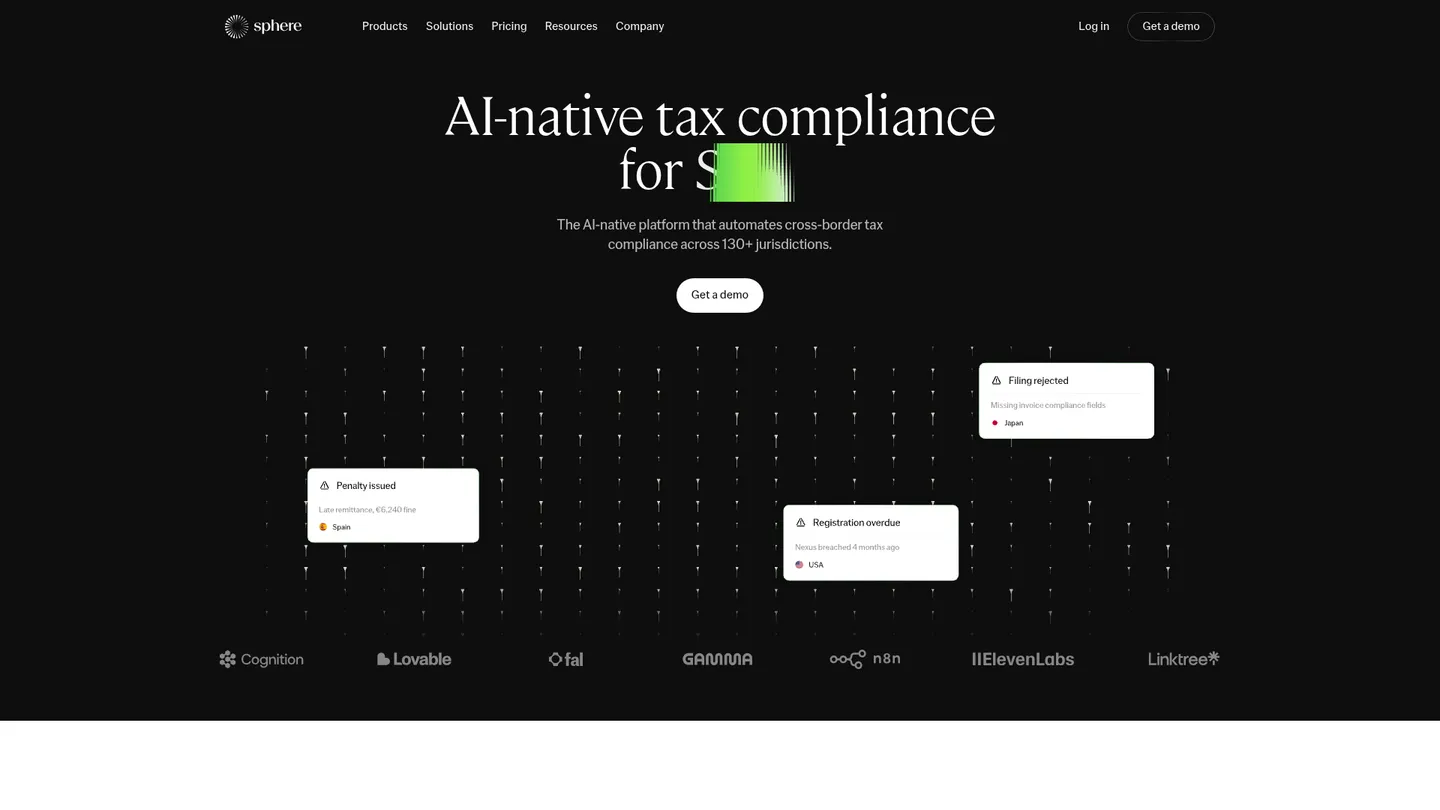
What is Sphere?
Founded in 2021 and headquartered in San Francisco, Sphere provides global indirect-tax automation for technology companies. Its platform covers 190+ countries and is backed by $25.3M, including a $21M 2025 Series A.
Sphere is a global indirect-tax compliance platform for businesses selling across borders. It monitors tax obligations, supports registrations, calculates tax at checkout or through an API, and automates filing and remittance. Its AI research engine, TRAM, reads tax law and rates; tax experts review determinations while a deterministic engine applies them in real time. The product is designed to replace fragmented local-provider workflows with one operating layer for sales tax, VAT, and GST.
The platform spans nexus and threshold monitoring, registration, tax calculation, returns, remittance, input-tax recovery, and e-invoicing. Sphere offers REST APIs, prebuilt billing and accounting connections, direct lines to 130+ tax authorities, and local rails for compliance. Its breadth is strongest for digitally delivered goods, subscriptions, and global technology businesses; buyers with unusual products, complex marketplace models, or specialist local requirements should validate coverage and filing scope before purchase.
Sphere is aimed at finance, tax, and operations teams at fast-growing technology companies expanding into multiple jurisdictions. Public pricing starts at $100 per region per month for the Starter plan, including monitoring, registration, calculation up to 50,000 transactions, filing, remittance, and local integrations. Growth is custom for 10 or more regions and adds e-invoicing. Sphere says deployment can take under 24 hours and provides Slack-based support.
Key features
Tax obligation monitoring
Monitors nexus, thresholds, tax rules, and rates across global jurisdictions so teams can identify registration obligations.
Global registration
Supports registration workflows across regions and connects directly with tax authorities to reduce country-by-country administration.
Real-time calculation
Calculates sales tax, VAT, and GST in real time through prebuilt connectors or a REST API for custom billing and checkout flows.
Returns and remittance
Automates filing and remittance on local schedules through direct authority connections and local compliance rails.
Input-tax recovery
Uses HRIS, payroll, expense, and accounts-payable data to identify recoverable input VAT, GST, and use tax under local deductibility rules.
E-invoicing
Creates compliant electronic invoices in mandated country formats and supports clearance and real-time reporting channels.
Tax research engine
TRAM researches and codifies tax law, rates, and rulings, with tax experts validating determinations and an audit trail.
Sphere pricing
Sphere’s Starter plan costs $100 per region per month and has no implementation fees or one-off costs. It includes calculation for up to 50,000 transactions, while Growth pricing is custom for 10 or more regions and includes e-invoicing. No third-party benchmark price was verified.
| Plan | Price | What's included |
|---|---|---|
| Starter | $100/region/moPublic price | Monitoring, registration, calculation up to 50,000 transactions, filing and remittance, local rails and integrations |
| Growth | CustomCustom pricing for 10+ regions | Global tax compliance plus e-invoicing |
Free trial: No public free-trial offer is listed.
Pros & cons
Pros
- Combines registration, calculation, filing, and remittance rather than limiting the product to a tax API.
- Direct connections to 130+ tax authorities support automation beyond a network of local intermediaries.
- Starter pricing is transparent at $100 per region per month and includes up to 50,000 calculated transactions.
- Prebuilt billing, ERP, accounting, and expense connections reduce implementation work for common finance stacks.
Cons
- The public Starter allowance is capped at 50,000 calculation transactions, with higher-volume and 10-plus-region deployments requiring custom pricing.
- Coverage and workflow fit should be validated for unusual products, marketplace models, and jurisdiction-specific edge cases.
- Sphere is designed primarily for cross-border indirect tax rather than income-tax provision or broader corporate tax work.
- The public site does not publish a detailed SLA, security-certification list, or complete implementation methodology.
Who is Sphere best for?
- Global technology companies expanding into multiple sales-tax, VAT, and GST jurisdictions.
- Finance teams replacing fragmented local tax providers with one registration-to-remittance workflow.
- Subscription and digital-goods businesses needing tax calculation connected to billing and checkout.
- Lean tax departments that need e-invoicing, input-tax recovery, and filing without building country-specific operations.
Coverage
Integrations
Notable customers
Frequently asked questions
How much does Sphere cost?
+
The public Starter price is $100 per region per month. It includes monitoring, registration, calculation up to 50,000 transactions, filing and remittance, and local rails and integrations. Growth pricing is custom for 10 or more regions.
How does Sphere work and how long does implementation take?
+
Sphere connects to billing, checkout, accounting, HR, payroll, or expense systems, calculates tax, and automates registration, filing, and remittance. The company says it can be deployed in under 24 hours, though timing depends on jurisdictions, registrations, data, and integration requirements.
How does Sphere compare with Avalara?
+
Sphere combines tax research, direct authority connections, registration, calculation, filing, and remittance in one platform, with a focus on fast-growing global technology companies. Avalara is a larger established tax-compliance suite; buyers should compare jurisdiction coverage, product-model support, integrations, service levels, and total cost.
What integrations does Sphere support?
+
Named prebuilt connections include Stripe, PayPal, Chargebee, QuickBooks, NetSuite, Zuora, Orb, and Maxio. Sphere also offers a REST API for custom billing and checkout flows and connects to HR and payroll platforms through Finch.
Who is Sphere for?
+
Sphere targets finance, tax, and operations teams at technology businesses selling internationally, particularly subscription, software, AI, and digital-goods companies. It is suited to organizations that need several indirect-tax jurisdictions managed without separate local providers.
Is Sphere secure and accurate enough for tax compliance?
+
Sphere says TRAM researches tax law, rates, and rulings, with tax experts validating determinations and a deterministic engine applying them with an audit trail. Buyers should request current security documentation, service commitments, and jurisdiction-specific accuracy or review procedures during procurement.
Sources
Facts and pricing verified on October 19, 2026. Vendors change pricing often, so confirm with Sphere before buying. How we research