
 Avalara
 Sovos
 Vertex
 Lukka
 Ledgible
What is TaxBit?
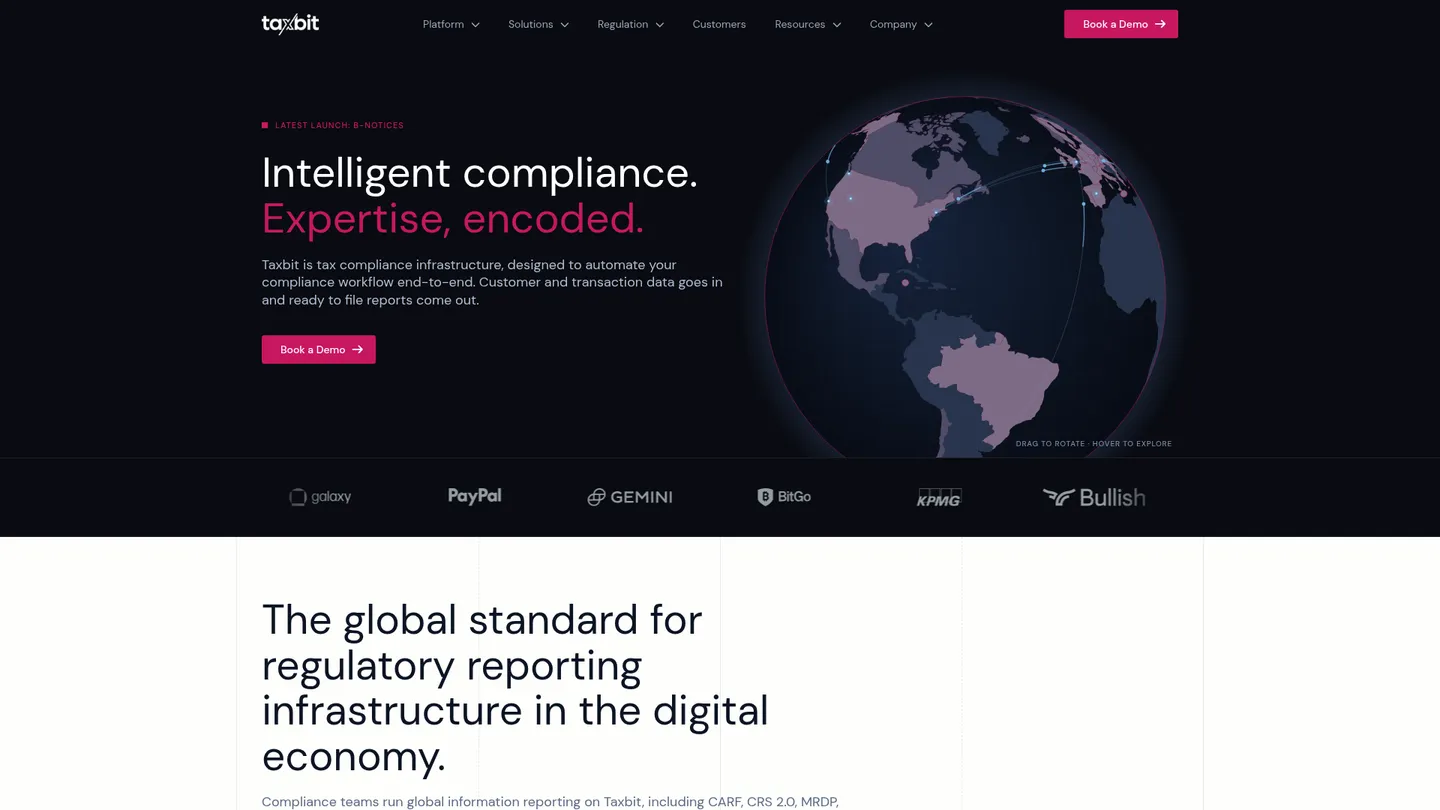
Founded in 2018 and headquartered in Draper, Utah, TaxBit provides enterprise tax and regulatory reporting infrastructure. Its platform serves 500+ companies across 70+ reporting jurisdictions and has processed 3B transactions.
TaxBit is an enterprise tax-compliance platform that takes customer and transaction data through onboarding, verification, determination, and reporting. Data enters through APIs, SDKs, or files; the system collects W-8 and W-9 forms, performs IRS TIN matching, checks foreign tax identifiers, determines reportability and cost basis, then files forms and delivers them to customers. Its rules engine supports jurisdiction-specific obligations and keeps an audit trail linking gains and losses to underlying transactions.
The platform covers information reporting, tax-document collection, cost basis, transaction classification, filing and delivery, corrections, notices, and global reporting. It supports U.S. 1099 reporting, CARF, CRS 2.0, DAC8, DAC7, SERR, FATCA, and W-8/W-9 workflows across 70+ jurisdictions. TaxBit says proposed AI actions receive human review and that it does not train models on customer data or send data to third-party AI vendors. Buyers should validate jurisdictional scope and accounting requirements for their specific use case.
TaxBit sells to digital-asset providers, exchanges, custodians, fintechs, payment providers, marketplaces, and traditional financial institutions, rather than individual filers. Named customers include PayPal, NYDIG, and Zero Hash; the company says 500+ companies use its platform. Pricing is quote-based and no public paid entry price or free trial is listed. Implementation typically involves a sales and technical evaluation, API or SDK integration, data mapping, and reporting-season readiness work. TaxBit is an active enterprise product. Its former consumer tax-filing offering is not the focus of this profile.
Key features
Tax document collection
Collects W-8, W-9, CARF, CRS, DAC7, and related self-certification documents through APIs and SDK components.
Identity verification
Matches U.S. taxpayer identification numbers with the IRS and validates foreign tax IDs and VAT numbers by format.
Reportability rules
Determines who is reportable, which form applies, and which jurisdiction governs each account.
Cost-basis calculation
Normalizes transaction data and calculates tax lots, cost basis, gains, losses, and income classifications.
Global information reporting
Automates preparation, filing, and delivery across U.S. forms and international regimes including CARF, CRS 2.0, and DAC8.
Corrections and notices
Handles post-filing corrections and notices within the same reporting workflow.
Audit trail
Links reported gains and losses to source transactions and records workflow activity for review.
TaxBit pricing
TaxBit does not publish subscription prices, a public plan table, or a paid entry point; enterprise buyers are directed to a sales evaluation. G2 lists no pricing available.
| Plan | Price | What's included |
|---|---|---|
| Enterprise | CustomCustom pricing | Tax-document collection, verification, reportability, filing, delivery, corrections, and API or SDK access scoped to the customer |
Free trial: No public free trial is listed.
Pros & cons
Pros
- Covers onboarding, verification, determination, filing, delivery, corrections, and notices in one workflow.
- Supports major digital-asset and international regimes including 1099-DA, CARF, CRS 2.0, and DAC8.
- Provides APIs, SDKs, and file ingestion for embedded and batch implementations.
- Publishes enterprise security controls including SOC 1 Type 2, SOC 2 Type 2, and ISO 27001:2022.
Cons
- Pricing is custom and no public paid entry price is available.
- The product is designed for organizations rather than individual tax filers.
- Implementation requires data, identity, jurisdiction, and reporting integration work.
- Exact connector names and commercial scope are not fully documented on the public pricing materials.
Who is TaxBit best for?
- Digital-asset providers and exchanges filing high-volume 1099 and international reports.
- Fintech and payment businesses embedding tax-document collection and reporting into customer workflows.
- Marketplaces and gig platforms reporting payments to large numbers of sellers or payees.
- Traditional financial institutions expanding into digital assets and global information reporting.
Coverage
Integrations
Notable customers
Frequently asked questions
How much does TaxBit cost?
+
TaxBit does not publish a starting price or self-serve plans. Enterprise pricing is quote-based and depends on reporting jurisdictions, transaction or account volume, selected modules, and implementation scope; G2 lists no pricing available.
How does TaxBit work and how long does implementation take?
+
Organizations send customer and transaction data through an API, SDK, or file, then TaxBit collects documentation, verifies identifiers, determines reportability, and files and delivers returns. The company does not publish a standard implementation timeline, so buyers should plan for data mapping, integration, testing, and reporting-season readiness.
How does TaxBit compare with Avalara?
+
TaxBit is focused on information reporting and compliance for the digital economy, including digital assets, CARF, CRS 2.0, and 1099-DA. Avalara has broader transaction-tax automation across sales tax, VAT, and similar indirect-tax use cases, so the closer fit depends on whether the primary need is information reporting or transaction tax.
What integrations does TaxBit support?
+
TaxBit supports API, SDK, and file-based data ingestion, and its documentation provides a React questionnaire SDK and server-side API authentication. The public integrations page also describes blockchain, exchange and custody, and accounting or ERP connectivity; specific connectors should be confirmed during procurement.
Who is TaxBit for?
+
TaxBit targets digital-asset providers, exchanges, custodians, fintechs, payment providers, marketplaces, and traditional financial institutions. It is built for enterprise compliance teams handling high-volume reporting rather than consumers preparing an individual return.
Is TaxBit secure and accurate enough for regulated reporting?
+
TaxBit's Trust Center lists SOC 1 Type 2, SOC 2 Type 2, ISO 27001:2022, ISO 27701, and ISO 27017, plus encryption, penetration testing, data segregation, and multi-availability-zone controls. The platform provides audit trails and human review for proposed AI actions, while customers remain responsible for validating configuration, source data, and filed reports.
Sources
Facts and pricing verified on October 19, 2026. Vendors change pricing often, so confirm with TaxBit before buying. How we research