
 Optro
 Workiva
 Diligent
 DataSnipper
 Caseware
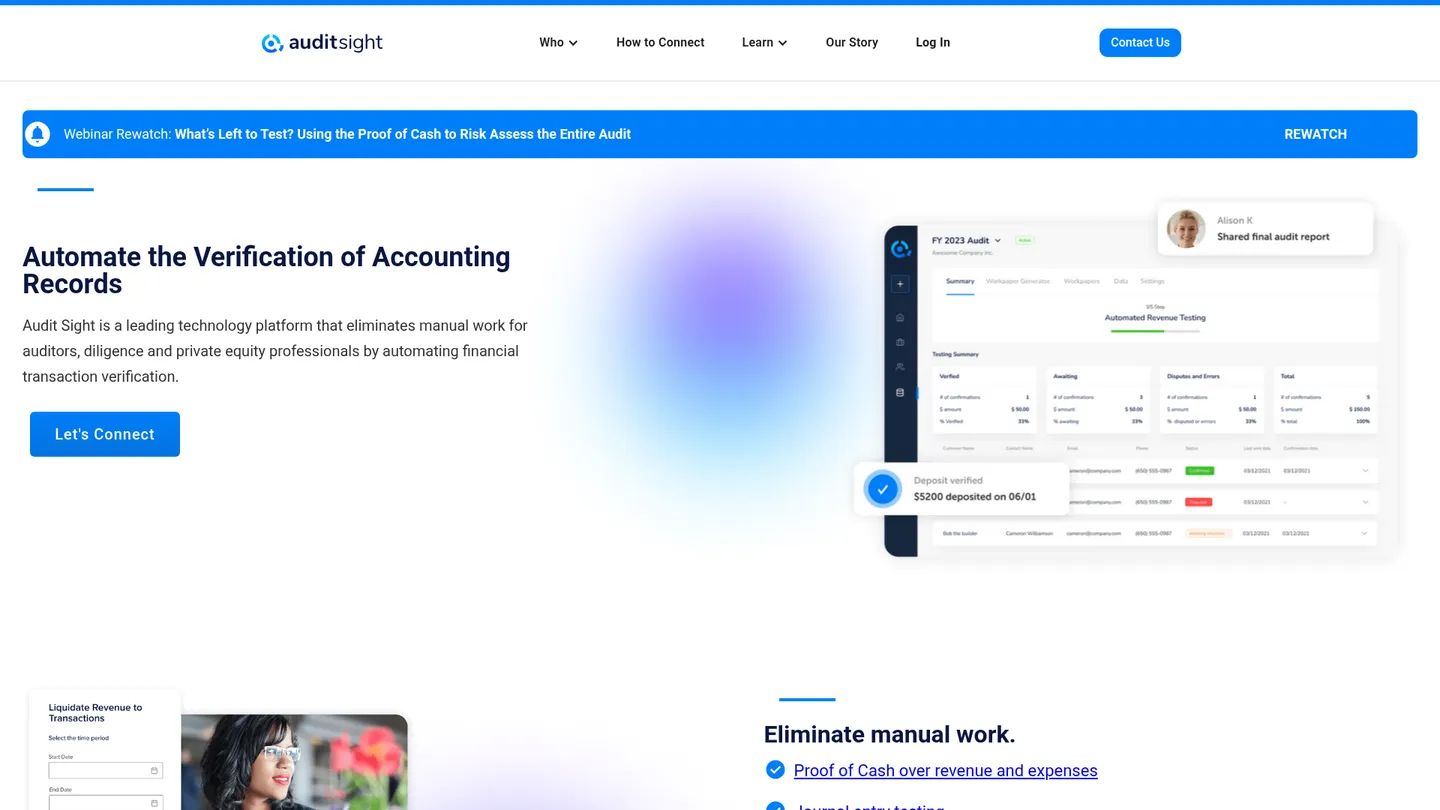
What is Audit Sight?
Founded in 2021 and headquartered in Atlanta, Audit Sight automates financial transaction verification for auditors and transaction-advisory teams. The company has raised $4 million in seed+ funding announced in 2022 and serves named accounting-firm customers.
Audit Sight is a cloud platform for verifying accounting records against independent banking and financial data. Teams can upload a general ledger or connect a client’s accounting and banking systems; the platform retrieves data, runs audit tests, and produces Excel-ready, GAAS-compliant workpapers. Its stated workflow covers transaction-level verification rather than sample-only testing, with client invitations and view-only connections designed to reduce the back-and-forth of traditional PBC collection.
The product combines proof of cash, revenue and expense analytics, journal-entry testing, financial-statement analytics, universal confirmations, and invoice-to-bank matching. It supports uploads, PDF bank statements, data conversion, and API connections, so teams are not limited to one source format. The practical limits are important: clients must complete authorization, some banks may provide partial history, and connection requirements vary by institution. Audit Sight says bank connections can cover more than 11,000 U.S. institutions, while connected banking history may be limited to 24 months depending on the bank.
Audit firms are the core buyer, with diligence providers, transaction-advisory practices, private equity firms, and venture investors also named as target users. Audit Sight says firms can be operational in 24 hours, receive an assigned customer-success team member, and give unlimited firm users access. Pricing is not published as a flat subscription: the company describes per-client, per-module pricing, while its analytics documentation describes per-entity pricing for that module. Buyers need a quote rather than a public self-serve plan.
Key features
Proof of cash
Ties revenue and expense analytics to bank activity to verify cash-backed transactions.
Journal-entry testing
Automates completeness checks and flags unusual revenue and journal-entry activity for review.
Financial analytics
Provides pre-built monthly and account-level flux analysis for P&L and balance-sheet review.
Universal confirmations
Supports external confirmations using firm templates, including accounts-receivable samples.
Invoice-to-bank matching
Matches invoices to cash receipts automatically when accounting-system data is connected.
Automated workpapers
Generates documented, Excel-ready workpapers intended to support GAAS procedures and review.
Data connections
Accepts uploads and read-only connections to accounting systems and bank accounts, including Plaid-powered banking access.
Audit Sight pricing
Audit Sight does not publish dollar pricing or standard tiers. Its how-to-connect page describes per-client, per-module pricing with unlimited users, while the audit-review analytics documentation describes per-entity pricing for that module and no extra fee for additional time periods. A sales conversation is required to price the selected modules and entities.
| Plan | Price | What's included |
|---|---|---|
| Audit modules | Custom | Proof of cash, journal-entry testing, financial-statement analytics, confirmations, invoice-to-bank matching |
| Audit and review analytics | Custom | Per-entity pricing, unlimited time periods, customizable anomaly thresholds |
| Transaction advisory | Custom | Financial transaction verification and diligence workflows |
Free trial: No public free trial; request a quote.
Pros & cons
Pros
- Combines proof of cash, journal-entry testing, confirmations, analytics, and invoice matching in one audit workflow.
- Supports uploads as well as read-only accounting and bank connections, including PDF and non-USD data workflows.
- Produces Excel-ready, GAAS-oriented workpapers and offers unlimited firm users with onboarding support.
- SOC 2 Type II compliance and view-only Plaid access address key controls for sensitive financial data.
Cons
- Pricing is quote-based, with no public dollar rates or self-serve plan.
- Client authorization and institution-specific requirements can delay or limit data connections.
- Bank history and coverage vary by institution, with the documented 24-month limit applying depending on the bank.
- The product is most relevant to professional audit and diligence teams rather than general accounting users.
Who is Audit Sight best for?
- CPA firms that want to automate tests of details and produce review-ready workpapers.
- Transaction-advisory teams that need faster verification of underlying accounting data.
- Private equity and diligence providers evaluating revenue, expenses, and cash activity.
- Audit teams willing to coordinate client connections for read-only banking and ledger data.
Audit areas and use cases
Integrations
Notable customers
Frequently asked questions
How much does Audit Sight cost?
+
Audit Sight does not publish a starting dollar price. Its public materials describe per-client, per-module pricing, and the audit-review analytics module uses per-entity pricing, so buyers need a tailored quote.
How long does implementation take, and how does it work?
+
Audit Sight says a firm can be up and running in 24 hours with minimal setup. The firm creates engagements and invites clients; clients authorize read-only connections or provide uploads, after which Audit Sight runs the tests and prepares workpapers.
How does Audit Sight compare with AuditBoard?
+
Audit Sight focuses on transaction verification and automated tests of details, including proof of cash and invoice-to-bank matching. AuditBoard is a broader audit-management and risk platform, so the closer fit depends on whether the priority is transaction evidence automation or end-to-end audit administration.
What integrations does Audit Sight support?
+
Documented accounting connections include QuickBooks Online, QuickBooks Desktop, Sage Business Cloud Accounting, Xero, and FreshBooks. Banking connections use Plaid and other providers, and teams can also upload templates, PDFs, and other files.
Who is Audit Sight for?
+
The primary audience is auditing firms, with transaction-advisory and diligence providers, private equity firms, and venture investors also identified as users. It is designed for teams verifying client accounting records, not for consumers or basic bookkeeping.
Is Audit Sight secure and accurate?
+
Audit Sight states that it maintains SOC 2 Type II compliance and that its bank connections are view-only, so the platform cannot move money or modify bank records. It retrieves source data for verification and produces documented workpapers, but reviewers still need to assess exceptions, source completeness, and professional judgments.
Sources
Facts and pricing verified on October 19, 2026. Vendors change pricing often, so confirm with Audit Sight before buying. How we research