
 Optro
 Workiva
 DataSnipper
 Caseware
 TeamMate+
What is MindBridge?
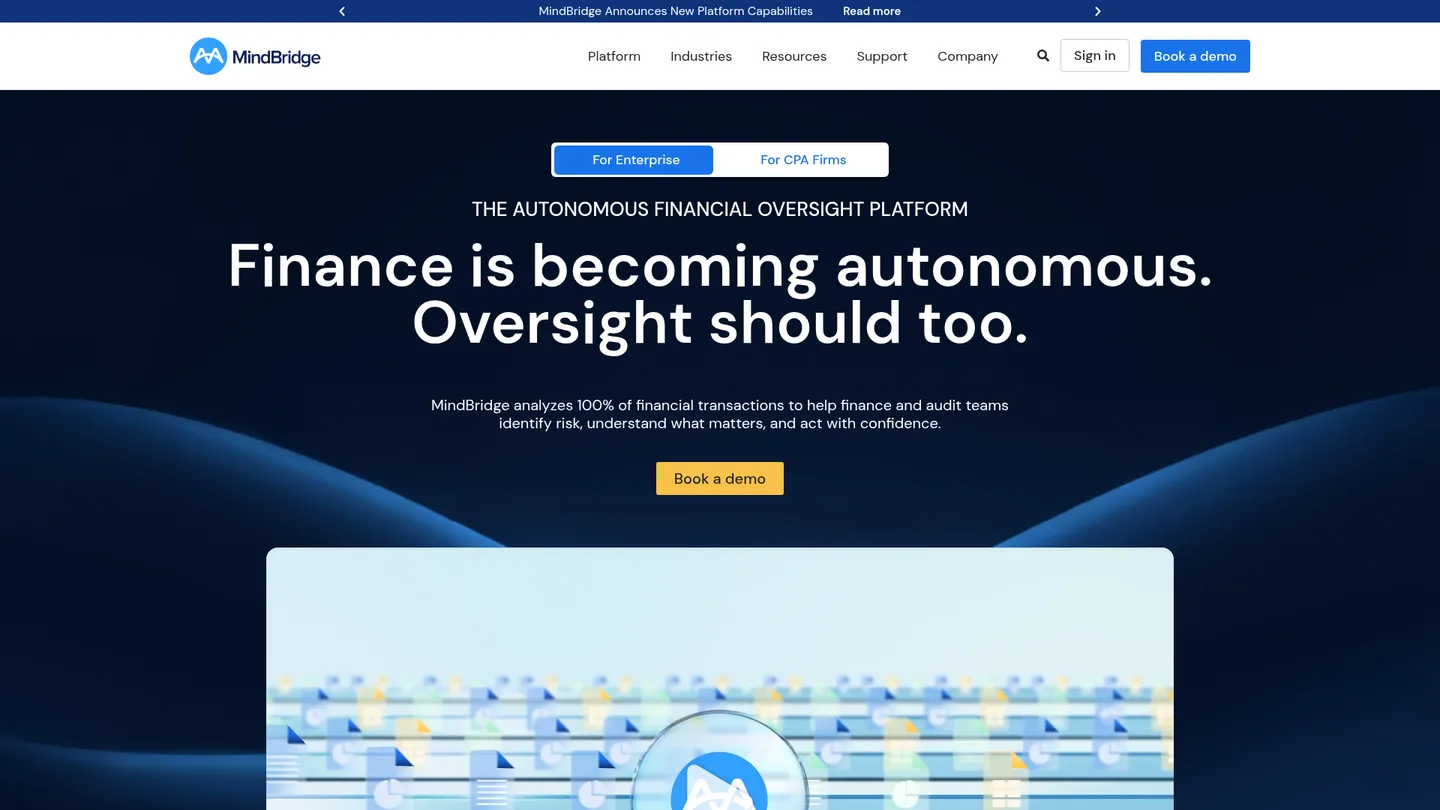
Founded in 2015 and headquartered in Ottawa, Canada, MindBridge provides AI-powered financial oversight for audit, finance, and assurance teams. Its platform analyzes full populations of transactions, identifies anomalies and potential fraud, and supports explainable investigation.
MindBridge is a cloud financial analytics platform for auditors, controllers, finance leaders, and risk teams. It ingests accounting and operational data from enterprise systems, applies ensemble AI and configurable control points, then risk-scores transactions and surfaces anomalies for investigation. Teams can examine general-ledger, vendor, revenue, payroll, credit-card, and subledger activity rather than relying only on samples. The platform includes dashboards, transaction-level explanations, workflow support, and APIs for embedding analysis into existing data and audit processes.
The product covers full-population risk assessment, anomaly and fraud detection, continuous controls monitoring, audit planning, subledger analysis, and financial data oversight. MindBridge says it analyzes 100% of transactions and has processed more than 135 billion transactions; those are vendor-reported scale figures, not an independent accuracy measure. Results still depend on the completeness, consistency, and mapping of source-system extracts. Its integrations and developer tooling reduce implementation friction, but enterprise deployments typically require data engineering and domain configuration.
MindBridge sells to accounting firms, internal-audit groups, finance organizations, and public-sector teams, with professional-services partnerships extending its reach. Public pricing is not listed, and the normal buying motion is a demo and custom subscription rather than self-serve checkout. A 2023 financing reported by BetaKit totaled $60 million USD, while PitchBook lists $82.2 million raised overall; neither source establishes a newer 2026 financing or a company acquisition. Buyers should request a quote based on data volume, users, modules, and deployment scope.
Key features
Full-population analysis
Analyzes entire transaction populations across financial systems instead of limiting review to traditional samples.
Anomaly detection
Uses ensemble AI and configurable control points to identify unusual transactions, patterns, and potential fraud.
Risk assessment
Ranks accounts, assertions, and transactions so audit teams can focus procedures on higher-risk activity.
Continuous monitoring
Supports recurring analysis and downstream workflows for ongoing financial-controls oversight.
Audit analytics
Provides dashboards, trends, segmentation, and transaction-level investigation for audit and assurance engagements.
Subledger analysis
Connects subledger analysis with audit workflow to assess detailed financial activity beyond the general ledger.
Developer integrations
Offers APIs, SDKs, and workflow guidance for connecting MindBridge to ERP, data, GRC, BI, and automation environments.
MindBridge pricing
MindBridge sells subscriptions through a sales-led quote process and does not publish list prices or self-serve tiers. Azure Marketplace provides a contact and demo route rather than a public subscription price.
| Plan | Price | What's included |
|---|---|---|
| Platform subscription | Custom | Financial analytics, risk scoring, dashboards, data integration and deployment scope agreed with sales |
Free trial: No public free trial is listed; request a demo and quote.
Pros & cons
Pros
- Examines full transaction populations and provides transaction-level risk explanations rather than relying solely on sampling.
- Supports multiple financial domains, including general ledger, subledger, vendor, revenue, payroll, and credit-card activity.
- Offers APIs and compatibility with Databricks, Snowflake, Microsoft Fabric, and Azure Data Factory.
- Has established enterprise relationships including KPMG, Genpact, BDO UK, and Chevron.
Cons
- Public pricing is unavailable, so buyers must complete a sales-led evaluation and quote process.
- Implementation depends on clean source extracts, data mapping, and specialist configuration.
- The platform is aimed at enterprise audit and finance workflows rather than small-business bookkeeping.
- AI risk scores prioritize investigation but do not replace auditor judgment or control testing.
Who is MindBridge best for?
- Large audit firms that need full-population transaction analytics across recurring engagements.
- Internal-audit and finance teams investigating anomalies across complex enterprise ledgers.
- Organizations building continuous controls monitoring into ERP and data-platform workflows.
- Advisory firms embedding explainable financial risk analytics into client engagements.
Audit areas
Integrations
Notable customers
Frequently asked questions
How much does MindBridge cost?
+
MindBridge does not publish a list price or self-serve plan. It sells through demos and custom quotes, with cost shaped by transaction volume, users, integrations, modules, and implementation scope.
How long does a MindBridge implementation take, and how does it work?
+
MindBridge ingests financial data, maps it to the platform, applies risk models and control points, and returns prioritized results for investigation. The company says its integration approach can reach first value in weeks, but enterprise timing depends on source-system readiness and mapping.
How does MindBridge compare with AuditBoard?
+
MindBridge is centered on transaction-level financial analytics, anomaly detection, and full-population risk assessment. AuditBoard is broader audit, risk, and compliance workflow software, so MindBridge fits detailed financial-data analysis better.
What does MindBridge integrate with?
+
MindBridge lists Databricks, Snowflake, Microsoft Fabric, and Azure Data Factory, plus 100+ API endpoints. APIs can connect financial systems, ERP data, GRC, business-intelligence, and automation workflows.
Who is MindBridge for?
+
Its buyers are audit and assurance firms, internal-audit departments, controllers, finance leaders, and advisory providers. Public examples include KPMG, Genpact, BDO UK, Buzzacott, and Chevron.
Is MindBridge secure and accurate?
+
MindBridge describes explainable AI with enterprise security, governance, and data-ownership controls, and says it has completed audits covering privacy, explainability, robustness, and bias. Accuracy depends on source-data completeness and mapping, so buyers should validate performance against historical data.
Sources
Facts and pricing verified on October 19, 2026. Vendors change pricing often, so confirm with MindBridge before buying. How we research