 Sovos
 ONESOURCE Pagero
 ONESOURCE
 Avalara
 Vertex
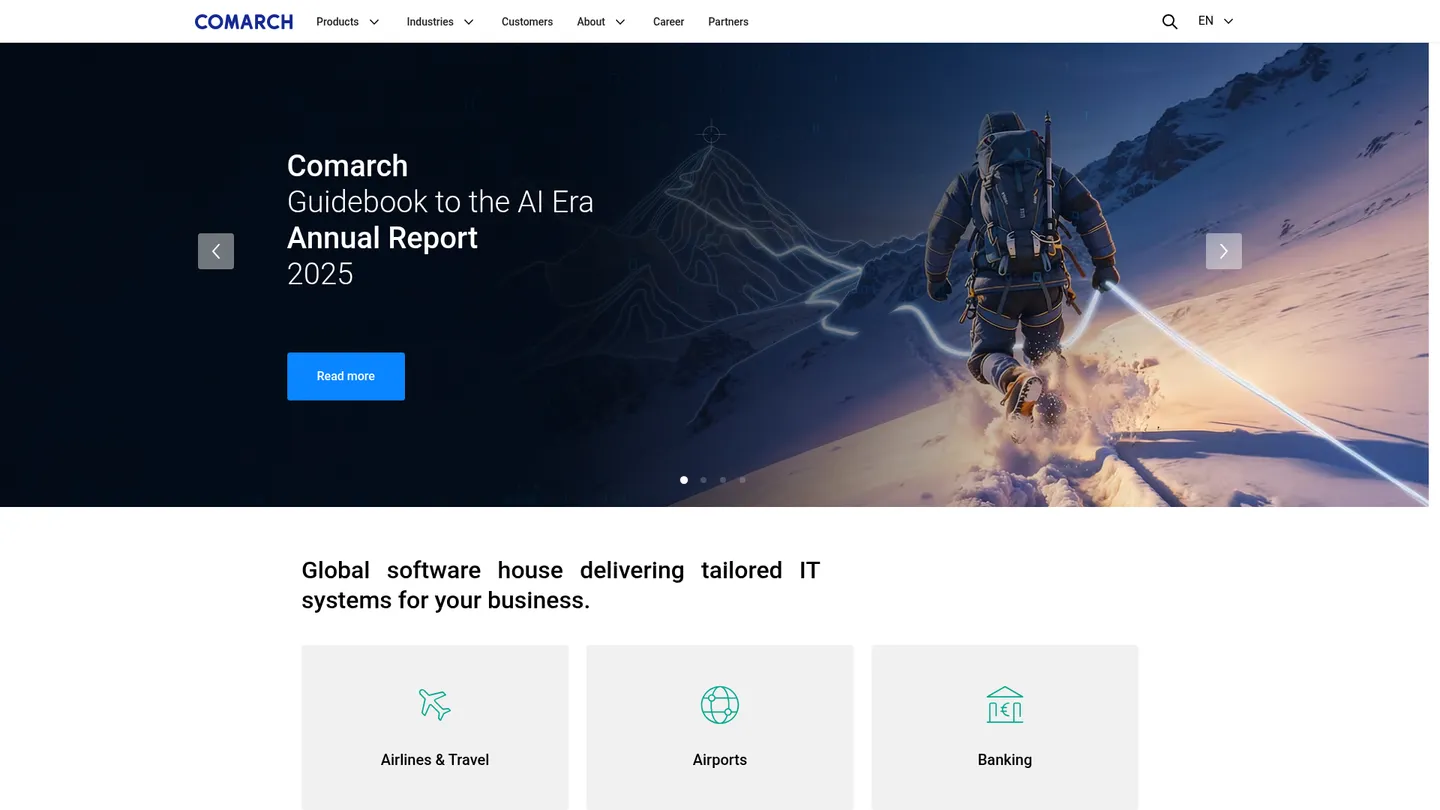
What is Comarch e-Invoicing?
Founded in 1993 and headquartered in Krakow, Poland, Comarch is a global software company with more than 6,500 employees. Its e-Invoicing platform automates AP and AR exchange, validation, archiving and compliance across 60+ countries.
Comarch e-Invoicing is an enterprise platform for receiving, processing, validating, sending and archiving invoices. It connects to an existing ERP, normalizes invoices from EDI, portals, email and scanned paper, and routes documents through local government platforms or PEPPOL. The product supports both accounts payable and accounts receivable, so buyers can automate inbound capture while suppliers and finance teams distribute compliant outbound invoices through a single service.
The feature set is broad: OCR and document capture, supplier self-onboarding, purchase-order flip, format conversion, multi-level validation, workflow, tracking, electronic signatures, e-Archive and multi-channel distribution. Comarch lists support for more than 60 countries and direct connections such as Poland’s KSeF, Italy’s SdI, France’s Chorus Pro and Romania’s RO e-Factura. This breadth suits multinational deployments, but the product is not self-serve software with published plans; implementation and country configuration require a structured project.
Comarch sells the platform primarily to multinational and larger mid-market organizations with complex ERP estates, multiple entities or cross-border invoicing obligations. Pricing is quote-based and tied to document volume, countries and integration complexity rather than a public per-user plan. Comarch states that mid-sized implementations can take 6–11 weeks, while large-enterprise projects may take 12 weeks to six months. Publicly named users include Agfa-Gevaert, Volotea, Ursus Breweries and TÜV SÜD.
Key features
AP invoice automation
Captures invoices from EDI, email, portals and scans, then uses OCR, indexing and workflow to process accounts payable documents.
AR e-invoicing
Generates outbound invoices from ERP data, converts them to recipient formats and distributes them through EDI, portal or email.
Government connectivity
Connects to PEPPOL and local platforms including KSeF, SdI, Chorus Pro and RO e-Factura for regulated exchange.
Validation and conversion
Applies technical, schema and business-rule checks and converts formats such as XML, UBL, IDOC, EDIFACT and PDF.
ERP integration
Supports ERP environments including SAP, Oracle, Microsoft Dynamics, NetSuite, Sage, Infor, JD Edwards and QuickBooks.
Archiving and audit trail
Stores invoices in a compliant e-Archive with search, retention controls, access management and document history.
Supplier collaboration
Provides self-service onboarding, invoice forms, PO-flip, tracking, alerts and multiple channels for suppliers with different technical capabilities.
Comarch e-Invoicing pricing
Comarch does not publish a standard entry price or self-serve tier. Official guidance says costs depend on document volume, countries and integration complexity. No verifiable public paid benchmark was found.
| Plan | Price | What's included |
|---|---|---|
| Enterprise deployment | Custom | Global compliance coverage, AP and AR processing, ERP integration, local government connectivity, validation, conversion and support |
| AP automation | Custom | OCR capture, supplier portal, workflow, validation, document management and e-Archive |
| AR e-invoicing | Custom | ERP data ingestion, format conversion, multi-channel delivery, tracking and archiving |
Free trial: No public free trial is listed; buyers request a quote and scope an implementation.
Pros & cons
Pros
- Covers AP and AR workflows, including OCR capture for suppliers that cannot send structured EDI.
- Supports 60+ countries and direct connections to several national e-invoicing platforms.
- Works with a wide range of ERP systems and preserves the customer’s existing core systems.
- Combines validation, tracking, legally oriented archiving and multi-channel delivery in one platform.
Cons
- Pricing is custom and there is no publicly verifiable entry price or free trial.
- Implementation can require a substantial project, especially across many countries, entities and ERP systems.
- The breadth of configuration is better suited to enterprise buyers than small businesses seeking instant setup.
- Public product-review evidence is limited compared with the largest dedicated e-invoicing competitors.
Who is Comarch e-Invoicing best for?
- Multinational finance teams that need one compliance layer across many countries and local mandates.
- Enterprises operating multiple ERP instances that want centralized invoice routing, conversion and validation.
- Organizations automating both inbound AP capture and outbound AR e-invoice delivery.
- Companies needing PEPPOL and government-platform connectivity without rebuilding integrations for each jurisdiction.
Coverage and use cases
Integrations
Notable customers
Frequently asked questions
How much does Comarch e-Invoicing cost?
+
Comarch uses quote-based pricing rather than publishing plans. Total cost depends on monthly document volume, countries and integration complexity.
How long does implementation take?
+
Comarch states that mid-sized implementations take 6–11 weeks. Large-enterprise projects can take 12 weeks to six months.
How does it compare with Sovos?
+
Both target multinational e-invoicing compliance, but Comarch emphasizes combined AP/AR, ERP integration, OCR and supplier collaboration. Buyers should compare country coverage, implementation scope and quotes.
Which systems integrate with it?
+
Comarch lists SAP, Oracle, Microsoft Dynamics, NetSuite, Sage, Infor, JD Edwards and QuickBooks. It describes the platform as ERP-agnostic and compatible with many other systems.
Who is it for?
+
It is designed for multinational and larger mid-market organizations with complex invoicing flows, multiple entities or changing country mandates. Case studies include Agfa-Gevaert, Volotea, Ursus Breweries and TÜV SÜD.
How does it address security and accuracy?
+
Comarch states that the platform is ISO/IEC 27001 certified and uses encryption at rest and in transit. Multi-level technical and business-rule validation stops erroneous documents before exchange.
Sources
Facts and pricing verified on October 19, 2026. Vendors change pricing often, so confirm with Comarch e-Invoicing before buying. How we research