
 Numeric
 FloQast
 BlackLine
 Workiva
 Trullion
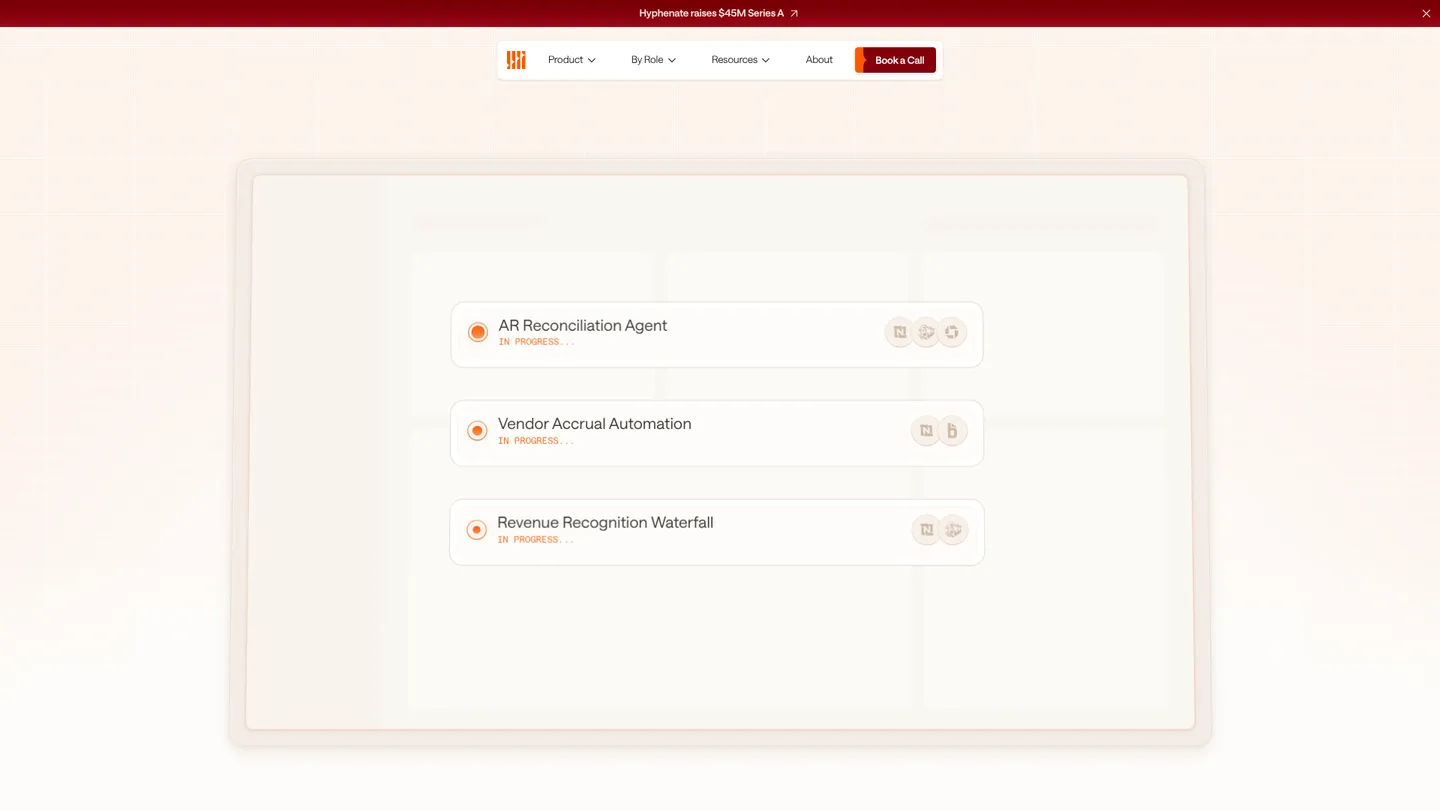
What is Hyphenate?
Founded in 2024 and headquartered in New York, Hyphenate is an autonomous finance platform formerly called Maximor. Its agents work across existing ERP, banking and finance systems; the company says it has raised $54 million, including a $45 million Series A in October 2026.
Hyphenate is an autonomous finance platform that layers agents onto a company’s existing ERP, banks, payroll and other systems rather than replacing them. It builds a shared finance context from ledger data, policies, workpapers, spreadsheets and operating history, then encodes company-specific accounting logic and exception handling. Agents continuously process, match, reconcile and post work, while people review judgment calls. The platform covers order-to-cash, treasury, general-ledger accounting, procure-to-pay and reporting, with source lineage and evidence attached to outputs.
Feature breadth is unusually wide for a finance automation product: contract parsing, ASC 606 and IFRS 15 revenue recognition, invoicing, collections, cash application, 13-week forecasting, reconciliations, accruals, fixed assets, prepaids, leases, R&D capitalization, intercompany accounting, controls monitoring, close management, flux commentary and board reporting. The vendor describes deterministic, explainable and auditable results, but independent accuracy benchmarks and broad third-party reviews are limited. Buyers should validate workflow coverage, approval controls, data lookback and exception behavior in a controlled pilot.
The primary buyer is a CFO, controller or finance-transformation team managing multiple entities, fragmented systems and repetitive accounting work. Public customer examples include Kiteworks, HiBid, Dura Software, Mini Melts USA and Synthesia; the company says six public companies use the platform. Pricing is not published: the services agreement puts fees, subscription term and any overages in an order form, with payment in US dollars. A demo is the public entry point, and the agreement allows free accounts or trial use when Hyphenate chooses to offer them.
Hyphenate news
Hyphenate raises $45M Series A
Led by Nexus Venture Partners with B Capital, bringing total funding to $54M less than a month after Maximor rebranded to Hyphenate. The company reports 86x revenue growth and says its agents run 90% of routine finance work on the platform.
Key features
Order-to-cash automation
Parses contracts, applies revenue policies, generates invoices, follows up on collections and matches incoming cash.
Treasury operations
Reconciles bank activity, flags exceptions and maintains a continuously updated 13-week cash forecast.
Close and reconciliations
Runs close tasks, reconciles accounts, drafts flux commentary and routes unresolved exceptions for approval.
General-ledger accounting
Maintains subledgers for fixed assets, prepaids, leases and R&D capitalization and proposes audit-trailed entries.
Procure-to-pay
Reads and codes bills, matches purchase orders, handles allocations and proposes accruals.
Intercompany controls
Supports eliminations, allocations, transfer pricing and reconciliations across entities, currencies and ERPs.
Reporting and insights
Maps ledger data into reports, answers finance questions in natural language and generates board-ready analysis.
Hyphenate pricing
Starting price: Custom (as of Nov 2026)
Hyphenate does not publish plan prices. Customer-specific fees, subscription terms and overages are specified in an order form, and fees are quoted in US dollars. The public website directs buyers to a demo rather than self-serve checkout.
| Plan | Price | What's included |
|---|---|---|
| Custom | Quote-based | Finance workflows selected in the order form, implementation and applicable support or service commitments |
Free trial: No standard public trial is advertised; the services agreement permits free accounts or trial use at Hyphenate’s discretion.
Pros & cons
Pros
- Covers five connected finance areas rather than a single point workflow.
- Supports major existing systems including NetSuite and SAP without a stated rip-and-replace requirement.
- Provides policy-aware approvals, source lineage and audit trails for agent work.
- Offers named customer case studies with implementation metrics such as Kiteworks going live in under four weeks.
Cons
- Pricing, plan limits and overage rates are not public.
- Independent review coverage and reproducible third-party accuracy benchmarks are limited.
- Implementation requires access to sensitive ERP, banking and finance data.
- The broad automation scope makes a workflow-by-workflow pilot and control review important before finance-wide deployment.
Who is Hyphenate best for?
- Controllers consolidating repetitive close and reconciliation work across multiple entities.
- CFO teams that want automation layered onto an existing ERP instead of an ERP migration.
- Finance organizations needing source-linked workpapers, approvals and audit evidence.
- Companies connecting revenue, treasury, accounting, payables and reporting workflows on shared context.
Coverage
Integrations
Notable customers
Frequently asked questions
How much does Hyphenate cost?
+
Hyphenate publishes no list price. Fees, subscription term and overages are set in a customer-specific order form, so buyers should request the billable unit, implementation charges and spend caps in writing.
How long does implementation take and how does it work?
+
Hyphenate says it can connect to existing systems without migration; its Kiteworks case study reports a go-live in less than four weeks. The platform first builds a finance context from connected data and company precedent, then agents execute work while people approve exceptions and judgment calls.
How does Hyphenate compare with BlackLine?
+
BlackLine is primarily associated with close, reconciliation and accounting automation, while Hyphenate positions itself across order-to-cash, treasury, GL accounting, procure-to-pay and reporting. The comparison should focus on required modules, ERP connectivity, control evidence and whether the team wants broader autonomous execution or a close-centered platform.
Which integrations does Hyphenate support?
+
The platform says it runs on top of major ERPs including NetSuite and SAP and connects with banking systems, payroll platforms, expense tools, email and spreadsheets. The full supported-object list is not public, so buyers should confirm their ERP edition, bank feeds and write-back permissions during evaluation.
Who is Hyphenate for?
+
It is designed for CFOs, controllers and finance-transformation teams handling multi-entity operations and repetitive accounting work. Public customer examples include Kiteworks, HiBid, Dura Software, Mini Melts USA and Synthesia.
Is Hyphenate secure and accurate enough for finance?
+
The Trust Center lists SOC 2 Type 2, SOC 1 Type 2, ISO 27701, ISO 27001 and PCI DSS 4.0.1, alongside security controls and subprocessors. Hyphenate describes source-linked, explainable outputs and human approval for judgment calls, but buyers should validate accuracy, access controls, audit evidence and failure handling with a controlled pilot.
Sources
Facts and pricing verified on November 1, 2026. Vendors change pricing often, so confirm with Hyphenate before buying. How we research
- Hyphenate homepage
- Platform
- Maximor rebrand announcement
- Series A announcement
- Trust Center
- Kiteworks case study
- Services Agreement
- Book a demo
- Nexus Venture Partners announcement
Work at Hyphenate or spot something out of date? Suggest a correction. We check every report against a public source and update the page, usually within a few days.