
 TaxJar
 Avalara
 Anrok
 Stripe Tax
 Vertex
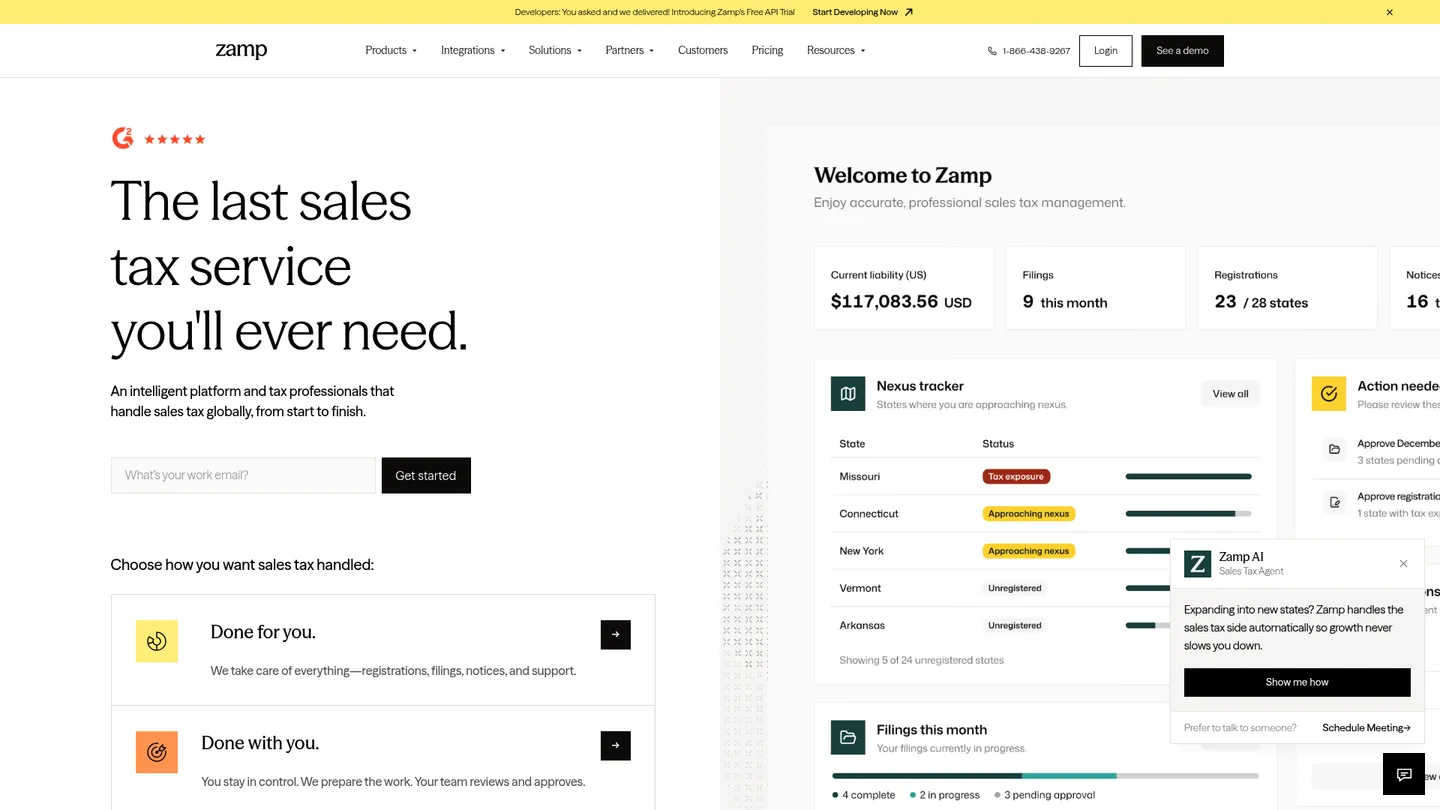
What is Zamp?
Founded in 2022 and headquartered in Miami, Zamp provides managed sales-tax compliance for growing businesses and accounting firms. Its software and tax professionals cover calculation, nexus, registration, filing, remittance, and notices, with 1,200+ finance and accounting teams listed on its pricing page.
Zamp combines sales-tax software with a managed team that handles the compliance lifecycle. Businesses connect transaction data through maintained commerce, ERP, billing, and accounting integrations or a REST API. The platform calculates rooftop-accurate tax, validates addresses, monitors economic nexus, supports registrations, prepares and submits returns, remits tax, and manages notices. Its API exposes calculations, transactions, product tax codes, registrations, and filing history, so teams can use Zamp inside an existing checkout or billing workflow.
The feature set spans exposure assessment, product taxability, rate determination, exemption and resale logic, nexus alerts, automated registration, filing and remittance, notice resolution, liability reporting, reconciliation, audit trails, and multi-entity operations. Coverage includes U.S. sales tax, Canada, and selected international VAT and GST use cases. Zamp lists 37 platform integrations and a free API sandbox, but the sandbox is rate-limited and temporary. International availability, filing scope, and connector behavior should be confirmed for each jurisdiction and system.
Zamp is built for e-commerce, SaaS, CPG, and other growing businesses that would rather outsource recurring sales-tax operations than maintain rate tables and filing calendars internally. Accounting firms can use referral and white-label offerings. Pricing is not a simple per-state table: the free tier covers assessment and sandbox access, while paid plans are custom-scoped to a company’s nexus, entities, products, transactions, and integrations. Zamp says API usage is based on committed transactions, not metered calls, and implementation can take days for connector-based migrations.
Key features
Tax calculation
Calculates rooftop-accurate tax using address validation, product taxability rules, and a jurisdiction-level breakdown.
Nexus monitoring
Tracks transaction exposure against economic-nexus thresholds and identifies where registration may be required.
Registrations
Automates state and territory registrations and maintains the registration footprint used by compliance workflows.
Filing and remittance
Prepares, submits, and remits returns while managing filing frequencies and deadlines.
Notice management
Monitors state portals, classifies notices with AI assistance, and supports expert-led response and resolution.
Compliance API
Provides authenticated endpoints for calculations, transactions, addresses, tax codes, companies, registrations, and filings.
Tax reporting
Delivers jurisdiction liability reporting, GL-ready reconciliation, transaction history, and multi-entity views.
Zamp pricing
Zamp publishes a free assessment and API sandbox, while its U.S. and U.S. plus Canada services are scoped to jurisdictions, entities, products, and systems. The company does not publish a paid entry price; Capterra lists vendor-contact pricing and no user reviews. Production API pricing is based on committed transactions rather than API calls.
| Plan | Price | What's included |
|---|---|---|
| Free | FreeFree assessment and sandbox access | Nexus and exposure assessment, product taxability review, expert consultation, and a rate-limited 30-day API sandbox |
| U.S. | CustomScoped to footprint | Calculation, nexus monitoring, registrations, filing and remittance, notice management, reporting, integrations, and tax-professional support |
| U.S. + Canada | CustomScoped to footprint | U.S. coverage plus Canadian GST, HST, PST, and QST calculation, registration, filing, reporting, and specialist support |
Free trial: Free 30-day, rate-limited API sandbox with no credit card; trial data is automatically deleted.
Pros & cons
Pros
- Combines calculation, nexus monitoring, registration, filing, remittance, and notice management.
- Uses precise address-based rates and returns a jurisdiction-level tax breakdown.
- Offers both maintained platform connectors and a documented REST API.
- Provides access to tax professionals and dedicated onboarding support.
Cons
- Paid plans require a scoped sales conversation rather than a published price table.
- The managed service is designed around Zamp-owned filings and remittance, which may limit teams seeking a calculation-only workflow.
- The free API sandbox is rate-limited and deletes trial data after 30 days.
- International coverage and connector availability vary by jurisdiction and use case.
Who is Zamp best for?
- Growing e-commerce businesses selling across multiple U.S. jurisdictions.
- SaaS and CPG companies needing managed registration, filing, and remittance.
- Finance teams that want a maintained connector or API rather than tax-rate tables.
- Accounting firms seeking referral or white-label sales-tax compliance services.
Tax coverage
Integrations
Notable customers
Frequently asked questions
How much does Zamp cost?
+
Zamp publishes a free plan for nexus and exposure assessment, product taxability review, expert consultation, and a 30-day API sandbox. U.S. and U.S. plus Canada plans are scoped to the company’s jurisdictions, entities, systems, and compliance needs, so no paid starting price is published.
How does Zamp work and how long does implementation take?
+
Zamp connects transaction data through pre-built connectors or its API, then supports nexus monitoring, registrations, calculation, filing, remittance, and notice management. Zamp says connector-based migrations can go live in days, while exact timing depends on the business footprint and existing tax accounts.
How does Zamp compare with TaxJar?
+
Zamp combines tax software with a managed service that handles registrations, filings, remittance, and notices. Its API supports rooftop-accurate calculations and transaction sync, while Zamp says production API usage is based on committed transactions rather than metered API calls.
What integrations does Zamp support?
+
Zamp lists 37 platforms, including Shopify, BigCommerce, Adobe Commerce, NetSuite, QuickBooks Online, Stripe, WooCommerce, Amazon, Chargebee, and Xero. Businesses can also build a REST integration using the Zamp API.
Who is Zamp for?
+
Zamp is aimed at growing e-commerce, SaaS, CPG, and other businesses with multi-jurisdiction sales-tax obligations. It also offers accounting firms referral and white-label options, including the Z-Tax product.
Is Zamp secure and accurate enough for tax compliance?
+
Zamp documents SOC 2 controls, encrypted data handling, audit-ready records, and access controls. Its API provides a full jurisdiction breakdown, and the company says its managed service covers filing and remittance; buyers should validate the applicable contractual guarantee and coverage during procurement.
Sources
Facts and pricing verified on October 19, 2026. Vendors change pricing often, so confirm with Zamp before buying. How we research