 ComplyAdvantage
 Hummingbird
 Unit21
 Feedzai
 Elliptic
What is AML Analytics?
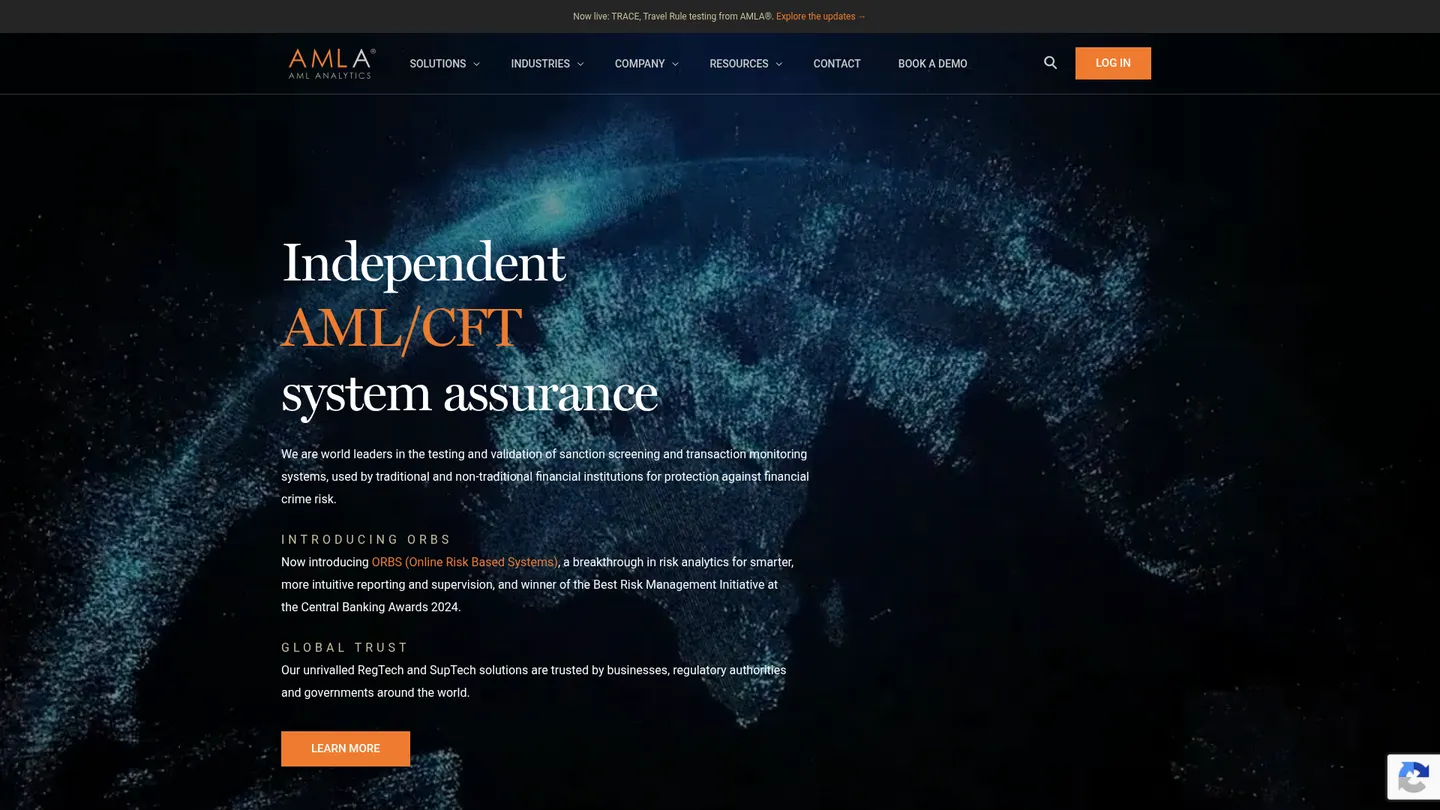
Founded in 2010 and headquartered in Hampshire, England, AML Analytics provides testing and validation technology for financial-crime controls. It serves 50+ supervisory authorities and 1,450+ financial institutions in nearly 60 countries.
AML Analytics (AMLA) provides independent testing, validation and benchmarking for sanctions-screening and transaction-monitoring systems. Its tools generate controlled test datasets, including sanctions-name manipulations and synthetic transaction scenarios, then compare customer results with benchmark or expected outcomes. The platform is used by financial institutions, supervisors and other regulated organizations to identify weaknesses, measure control effectiveness and support evidence-based reporting to regulators.
The product range covers self-service sanctions testing through Sandbox, peer benchmarking through Global Benchmark, result analysis through Analyser Online, tailored Annual Assurance Testing, transaction-monitoring health checks and recurring validation through TMV, and free sanctions-list alerts through SAS/SAT. Public materials document AMLA Hub single sign-on and ORBS integration, but do not identify connectors to named third-party screening or monitoring vendors. Public security pages describe testing without customer-data access, but do not verify specific certifications or infrastructure controls.
AMLA sells subscription services such as Global Benchmark and Annual Assurance Testing, while its Sanctions Alert Service is described as free. Dollar pricing, named paid tiers, free-trial terms and volume schedules are not publicly disclosed, so buyers should expect a quote-based process for commercial products. The company says it serves more than 1,450 financial institutions and 50 supervisory authorities across nearly 60 countries, with work spanning traditional and non-traditional financial institutions.
AML Analytics news
Covalent Equity Partners invests in AML Analytics
A growth investment (amount not disclosed) to accelerate AI-powered testing of AML and sanctions controls and extend AML Analytics' data to tier-one banks and regulators.
Key features
Sandbox testing
Self-service sanctions-screening tests use configurable sources, record types, matching algorithms and synthetic records without requiring IT integration or customer-data access.
Global benchmarking
Annual benchmark testing compares customer- and transaction-screening performance with aggregated peer scores across control and manipulation levels.
Result analytics
Analyser Online provides secure access to test results, metrics, graphs, diagnostic views and downloadable benchmark files.
Assurance testing
Annual Assurance Testing provides subscription testing tailored to an institution’s requirements and risk appetite.
Red-flag testing
Smart Scenarios use millions of synthetic transaction rows to exercise transaction-monitoring rules against defined money-laundering typologies.
Monitoring validation
Transaction Monitoring Validator supports ongoing or frequent validation of transaction-monitoring systems against current regulatory requirements.
Sanctions alerts
SAS/SAT provides free real-time alerts and updated screening tests for important global sanctions-list changes.
AML Analytics pricing
Starting price: Custom (as of Nov 2026)
AMLA does not publish dollar pricing, named paid tiers, free-trial terms or seat and volume schedules. Global Benchmark and Annual Assurance Testing are positioned as subscription products, while the Sanctions Alert Service is explicitly free. Buyers should request a quote for commercial testing and validation services.
| Plan | Price | What's included |
|---|
Free trial:
Pros & cons
Pros
- Tests can be run without IT integration or access to customer data.
- Coverage includes both sanctions screening and transaction monitoring.
- Global Benchmark provides peer comparisons rather than isolated test results.
- Recent updates add more than 50 multi-manipulation sanctions scenarios and expanded name-variation testing.
Cons
- Commercial pricing, tiers and trial terms are not publicly disclosed.
- Public materials do not document connectors to named third-party screening or monitoring vendors.
- The product is specialized for control testing rather than a complete AML case-management platform.
- Specific security certifications, data residency details and service-level commitments are not publicly verified.
Who is AML Analytics best for?
- Financial institutions needing independent testing of sanctions-screening controls.
- Regulators conducting thematic reviews across multiple financial institutions.
- Compliance teams that need synthetic transaction scenarios for monitoring validation.
- Organizations seeking benchmark evidence for regulatory reporting and remediation.
Use cases
Integrations
Notable customers
Frequently asked questions
How much does AML Analytics cost?
+
AMLA does not publish dollar pricing, named paid tiers or volume schedules. Global Benchmark and Annual Assurance Testing are subscription products priced through a quote-based process, while the Sanctions Alert Service is described as free.
How does AML Analytics testing work?
+
AMLA generates controlled sanctions or synthetic transaction datasets, which customers run through their own screening or monitoring systems. Results are uploaded or assessed for effectiveness, efficiency and defined control weaknesses, with outputs available through Analyser Online.
How does AML Analytics compare with ComplyAdvantage?
+
AML Analytics tests and benchmarks existing financial-crime controls rather than replacing the underlying screening or monitoring system. Buyers considering ComplyAdvantage should distinguish the purchase of operational controls from the independent validation and assurance role described here.
What integrations does AML Analytics support?
+
The documented integrations are AMLA Hub single sign-on and ORBS, which supports sharing results and risk assessments with regulators. Public pages do not identify integrations with named commercial sanctions-screening or transaction-monitoring vendors.
Who is AML Analytics for?
+
AMLA is designed for financial institutions, supervisory authorities and other regulated organizations that need to test or validate sanctions-screening and transaction-monitoring controls. The company says it serves 50+ authorities and 1,450+ financial institutions across nearly 60 countries.
Is AML Analytics secure and accurate?
+
Sandbox testing does not require customer-data access or IT integration, and Analyser Online uses secure credentials. Public materials describe testing and benchmark methodology, including a reported 10% accuracy uplift across the South African market after a 2017 thematic review, but do not verify specific security certifications.
Sources
Facts and pricing verified on November 1, 2026. Vendors change pricing often, so confirm with AML Analytics before buying. How we research
- AML Analytics company overview
- AML Analytics 15-year anniversary
- Covalent Equity Partners investment announcement
- AML Analytics Sandbox
- AML Analytics Global Benchmark
- AML Analytics Analyser Online
- AMLA Hub and Analyser Online update
- Expanded sanctions testing
- LinkedIn company profile
Work at AML Analytics or spot something out of date? Suggest a correction. We check every report against a public source and update the page, usually within a few days.