
 Alloy
 ComplyAdvantage
 Sumsub
 Trulioo
 Persona
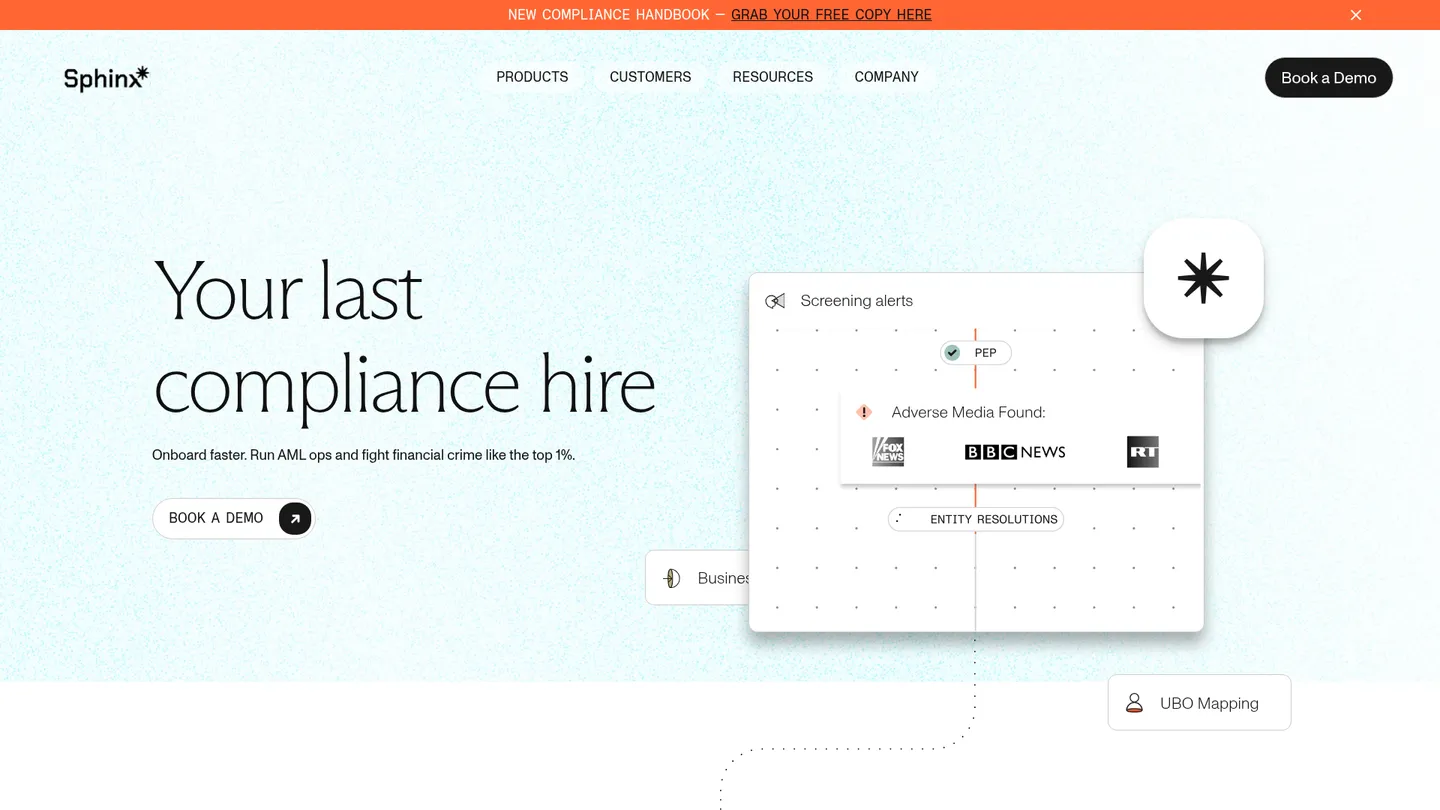
What is Sphinx?
Sphinx builds AI compliance analysts for banks, fintechs and regulated companies. Its agents investigate cases, document decisions and reduce repetitive analyst work inside existing compliance systems.
Sphinx is an AI compliance-operations platform for banks, fintechs and other regulated businesses. Its agents sign into systems a team already uses, gather evidence from connected tools and the open web, investigate alerts, and write findings back into existing workflows. Agents support customer and business onboarding as well as post-alert investigation, with browser-based deployment designed to avoid platform migrations or large engineering projects. Human reviewers can inspect the evidence and reasoning before acting.
The product spans KYC and KYB, UBO mapping, sanctions and PEP screening, adverse-media research, document intelligence, transaction-monitoring alert disposition, enhanced due diligence, continuous rescreening, case management and SAR/UAR drafting. Sphinx says decisions carry evidence and audit logs, and it is SOC 2 Type II certified and GDPR compliant. It is an investigation and operations layer rather than a replacement for every underlying screening, identity or transaction-monitoring provider. Connector and jurisdiction coverage should be confirmed during implementation.
Sphinx targets compliance teams with high alert volumes, onboarding backlogs or limited analyst capacity, especially banks, fintechs, crypto businesses and credit unions. The company sells through demos and does not publish a general subscription price for the core platform; pricing is custom. Its separate Watchdoc document-fraud product publishes usage pricing, but that is not the broader platform price. Deployment can use browser logins, APIs where available, or the Sphinx API and webhooks.
Key features
KYC automation
Agents verify identity documents, confirm addresses, handle RFIs and work screening alerts.
KYB and UBO mapping
Agents research business presence, map beneficial ownership and apply onboarding logic to complex structures.
Alert disposition
Agents investigate sanctions, PEP and adverse-media alerts and preserve an audit trail.
Transaction monitoring
Agents analyze patterns, counterparties and context to resolve flagged cases.
Enhanced due diligence
Agents conduct research, detect red flags, verify source of funds and prepare RFIs.
Continuous monitoring
Scheduled KYC and KYB rescreening surfaces changes on hourly, daily or weekly schedules.
SAR and UAR filings
Agents draft structured SAR/UAR narratives with supporting evidence for review.
Sphinx pricing
Sphinx does not publish core-platform pricing and directs buyers to a demo. Pricing is custom. A separate Watchdoc product lists $0.45 per document and a free 50-document tier, but it is distinct from the core platform.
| Plan | Price | What's included |
|---|---|---|
| Core platform | CustomDemo required | AI agents, workflow configuration, investigations, case work and audit trails |
| Watchdoc free test | FreeSeparate product | 50 documents, verdict and evidence |
| Watchdoc live | $0.45/documentSeparate product | API scanning, evidence, webhooks and no minimums |
Free trial: No public free trial is listed for the core platform; book a demo.
Pros & cons
Pros
- Browser agents work inside existing compliance tools without a platform migration.
- Coverage extends from onboarding and UBO research through alert disposition and SAR/UAR drafting.
- Decision trails preserve evidence, sources and reasoning behind agent work.
- Custom workflows let institutions set routing and resolution logic around their procedures.
Cons
- Core-platform pricing is quote-based, making budget comparison difficult.
- Sphinx does not replace underlying screening, identity and transaction-monitoring providers.
- AI dispositions still require human oversight for ambiguous or high-risk cases.
- Connector and jurisdiction coverage should be confirmed during implementation.
Who is Sphinx best for?
- Banks and fintechs handling large volumes of KYC, KYB or AML alerts.
- Compliance teams needing investigation automation without replacing existing systems.
- Regulated businesses clearing onboarding backlogs with small analyst teams.
- Teams requiring evidence-backed decisions and auditable case histories.
Coverage
Integrations
Notable customers
Frequently asked questions
How much does Sphinx cost?
+
Sphinx does not publish core-platform pricing; buyers request a demo and custom quote. Its separate Watchdoc product lists $0.45 per document and a free 50-document tier.
How does Sphinx work and how long does processing take?
+
Agents use browser credentials or APIs to work inside existing tools. Sphinx estimates about 90 seconds for AML watchlist checks and about four minutes for a full KYB investigation, varying by case complexity.
How is Sphinx different from Alloy?
+
Alloy is primarily an identity and decisioning platform, while Sphinx focuses on analyst work around alerts: research, evidence, disposition and documentation. Sphinx can sit on top of existing systems rather than replacing the stack.
What integrations does Sphinx support?
+
Sphinx documents ComplyAdvantage and TRM Labs integrations. Browser agents can use login access, and the API supports case creation, document upload and webhooks.
Who should buy Sphinx?
+
Sphinx is designed for banks, fintechs, crypto businesses, credit unions and other regulated companies with repetitive KYC, KYB, AML or transaction-monitoring casework. It is most relevant when alert volume or analyst capacity is the constraint.
Is Sphinx secure and accurate enough for regulated work?
+
Sphinx states that it is SOC 2 Type II certified and GDPR compliant, with evidence and audit trails for decisions. It reports 98% same-day case resolution and 87% fewer false positives; buyers should validate these claims against their own data.
Sources
Facts and pricing verified on October 19, 2026. Vendors change pricing often, so confirm with Sphinx before buying. How we research