 Vanta
 Secureframe
 Sprinto
 Hyperproof
 Optro
What is Drata?
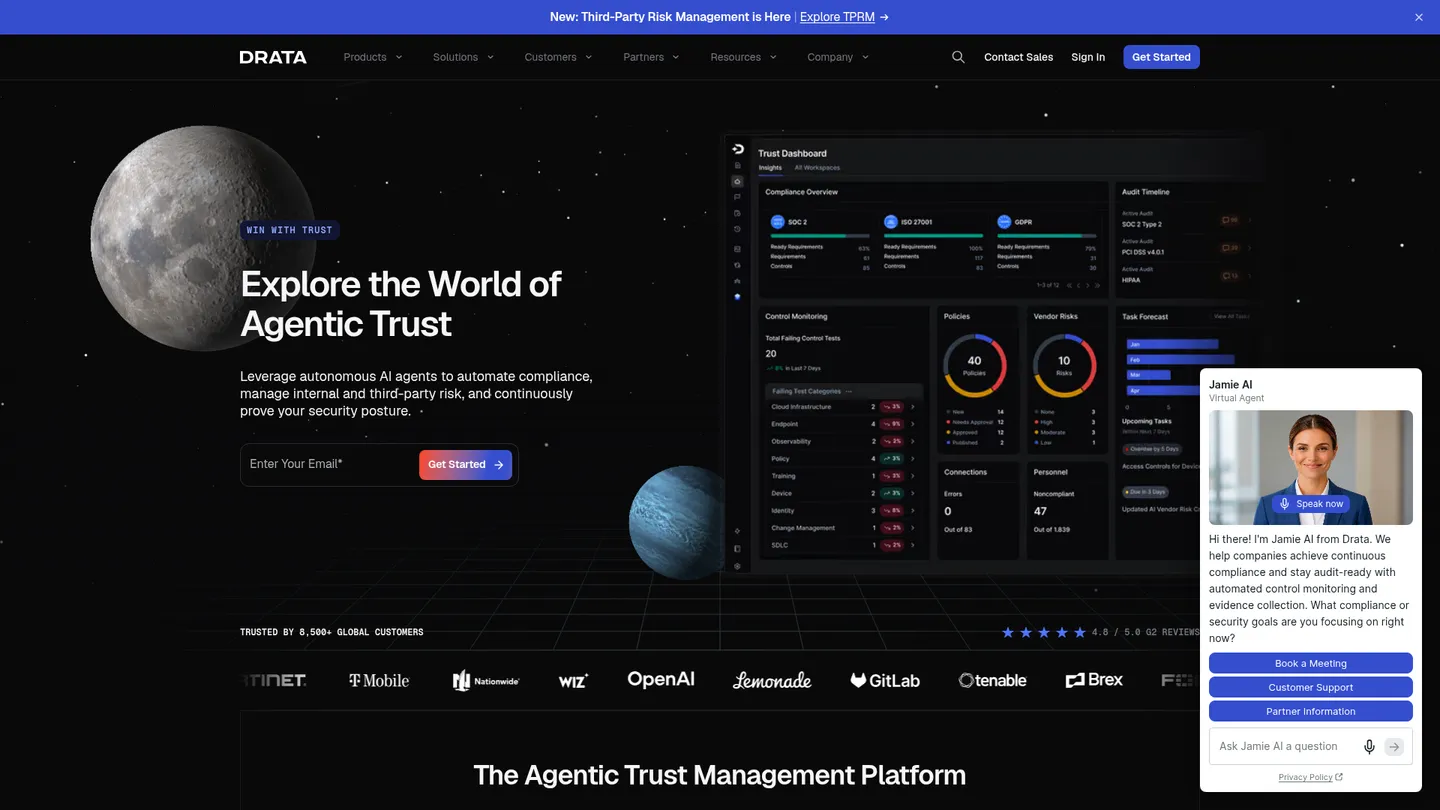
Founded in 2020 and headquartered in San Francisco, Drata automates evidence collection, control monitoring, risk management and trust workflows. It reports 7,000+ customers in 60 countries and 300+ integrations.
Drata is a compliance automation platform that connects to a company’s technology stack, maps controls to frameworks and continuously collects evidence. Its dashboards track readiness, control status, personnel tasks, policies, risks and auditor requests. The platform supports multiple control owners, raw JSON evidence export, Audit Hub for auditor communications and document storage, Compliance as Code, API access, role-based access controls and workspaces. This replaces much of the spreadsheet and screenshot work involved in preparing for recurring audits.
The product includes distinct GRC and Assurance families, plus Trust Center and third-party risk capabilities. GRC Foundation, Advanced and Enterprise plans add framework coverage, custom connections and tests, custom fields and formulas, access reviews, risk capabilities, Compliance as Code options and API access. Assurance separately covers branded Trust Center, questionnaire workflows, approved domains, access controls, integrations, portals and higher API or webhook capacity.
Drata is aimed at startups and growth companies preparing for SOC 2, ISO 27001, HIPAA or GDPR, as well as larger teams managing several frameworks, customer reviews or vendor-risk programs. Its own site uses contact-sales pricing, while AWS Marketplace lists a Foundation package for 1–50 FTEs at $15,000 per year. Vendr reports median buyer spend of $24,934 annually across 236 purchases, with observed transactions from $9,415 to $68,250; those figures are third-party procurement benchmarks, not Drata list prices.
Key features
Automated evidence collection
Connects to business and infrastructure systems to collect documentation and monitor evidence against mapped controls.
Framework mapping
Maps shared controls across SOC 2, ISO 27001, HIPAA, GDPR and other available frameworks.
Continuous control monitoring
Runs automated tests and provides readiness dashboards that surface control gaps and failed checks.
Audit collaboration
Audit Hub centralizes auditor communications, requests and supporting documents.
Trust Center
Publishes security reports, policies and other documentation through branded customer-facing portals with access approvals.
Risk management
Provides risk registers, scoring, custom risk rules and internal and third-party risk workflows.
Questionnaire automation
Uses AI assistance to draft responses to uploaded security questionnaires, with plan-based questionnaire limits.
Drata pricing
Drata’s public plans page does not publish direct dollar pricing and routes buyers to sales. AWS Marketplace lists a 1–50 FTE Foundation package at $15,000 for 12 months; this is the lowest verifiable paid public entry. Vendr’s third-party benchmark across 236 purchases reports median spend of $24,934/year, an observed range of $9,415–$68,250 and average savings of 23%, so it is directional procurement evidence rather than a Drata rate card.
| Plan | Price | What's included |
|---|---|---|
| Foundation | From $15,000/yr on AWS MarketplaceGRC package for 1–50 FTEs; direct pricing is quote-based. | One pre-mapped framework, automated evidence collection, pre-built integrations, risk management, custom controls, Compliance as Code and Open API access |
| Advanced | CustomGRC plan. | Any available framework, custom connections and tests, custom fields and formulas |
| Enterprise | CustomGRC plan. | Risk Management Pro, Compliance as Code Pro and User Access Review |
Free trial: Demo available; no public trial offer.
Pros & cons
Pros
- Broad framework mapping lets teams reuse shared controls across multiple programs.
- Continuous evidence collection reduces recurring spreadsheet and screenshot work.
- A large integration catalog and REST Open API support complex technology stacks.
- Trust Center, questionnaire assistance and third-party risk extend beyond audit preparation.
Cons
- Direct pricing is quote-based, and framework or module add-ons can increase total cost.
- Foundation GRC is limited to 50 FTEs and one pre-mapped framework.
- Some advanced API, webhook, data warehouse and access features require higher plans or Assurance options.
- AWS Marketplace orders are annual and listed as non-cancellable and non-refundable.
Who is Drata best for?
- Startups preparing for SOC 2 with a cloud-based technology stack.
- Growth companies adding ISO 27001, HIPAA, GDPR or other frameworks.
- Security and GRC teams managing continuous evidence collection across many systems.
- Larger organizations combining compliance, Trust Center and third-party risk workflows.
Frameworks and use cases
Integrations
Notable customers
Frequently asked questions
How much does Drata cost?
+
Drata’s direct plans are quote-based. AWS Marketplace lists a 1–50 FTE Foundation package at $15,000 for 12 months, while Vendr reports median buyer spend of $24,934 per year across 236 purchases.
How does Drata work and how long does setup take?
+
Drata connects to cloud infrastructure, HR, identity, ticketing and version-control tools, then maps collected evidence to controls and frameworks. Audit Hub centralizes auditor communications and evidence requests while continuous checks keep the readiness dashboard updated.
How does Drata compare with Vanta?
+
Both platforms automate evidence collection and compliance monitoring for common frameworks. Drata’s documented scope includes Trust Center, third-party risk, Compliance as Code, Audit Hub and tiered API and data warehouse capabilities.
What integrations does Drata support?
+
Drata supports more than 580 integrations across HRIS, SSO, cloud, DevOps, ticketing, vulnerability management, training and other categories. Named integrations include AWS, Azure, Google Cloud, BambooHR, ADP, Jira, Slack and Salesforce, with a REST Open API for custom connections.
Who is Drata best suited for?
+
It suits startups and growth companies preparing for SOC 2, ISO 27001, HIPAA or GDPR, plus larger teams with multiple frameworks or customer security reviews. Foundation has a published 50-FTE limit, while larger programs should validate framework, workspace, API and support requirements in the quote.
Does Drata improve compliance accuracy and security?
+
Drata continuously tests controls and collects evidence, but teams still need to review failed tests, policies and AI-generated questionnaire responses. Drata reports 90% AI-response accuracy on customer materials, while G2 reviews note that some integrations may require custom evidence collection or troubleshooting.
Sources
Facts and pricing verified on October 19, 2026. Vendors change pricing often, so confirm with Drata before buying. How we research