
 MetricStream
 Resolver
 Optro
 Workiva
 Onspring
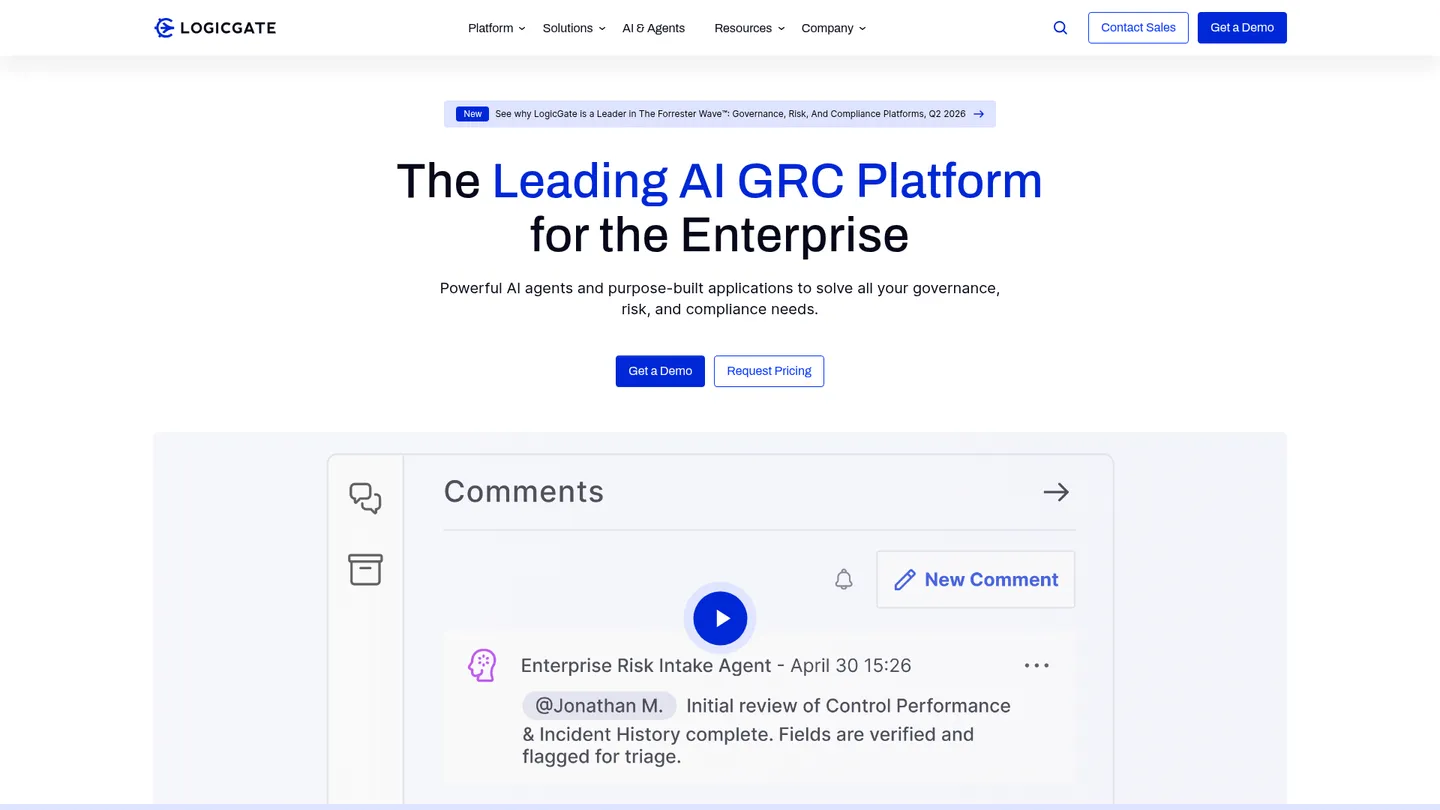
What is LogicGate Risk Cloud?
Founded in 2015 and headquartered in Chicago, LogicGate provides Risk Cloud, a configurable GRC platform with 30+ applications and dozens of integrations. It serves hundreds of customers, including SoFi, Zurich Insurance, Memorial Hermann Health and Cimpress.
LogicGate Risk Cloud is a configurable, cloud-based GRC platform built around applications: purpose-built collections of rules and workflows for enterprise risk, regulatory compliance, third-party risk and audit. Its no-code interface lets GRC teams build and modify processes without traditional development, while graph-database technology connects risk and compliance data. Power Users administer applications and permissions; Standard Users interact with records, tasks, reports and dashboards; External Users can complete questionnaires through one-time passcodes.
The platform spans more than 30 applications, including risk management, compliance, audit, controls, policy, third-party risk and security programs. It supports custom workflows, dashboards, reporting, REST API connectivity, native integrations and optional risk quantification. That breadth is useful for organizations consolidating GRC processes, but implementation requires configuration and program ownership. G2 reviewers praise ease of use and customization while noting a learning curve and that advanced reporting can require additional configuration.
LogicGate targets mid-market and enterprise GRC, risk, compliance, security and audit teams rather than small businesses seeking a self-serve checklist product. Pricing is quote-based and modular: customers select applications and Power User licenses, then add features, connectors and services. Standard and External Users are included at no additional license cost. Vendr reports a median buyer price of $53,784 per year, while AWS Marketplace has no verified Risk Cloud product price.
Key features
Enterprise risk management
Centralizes risk registers, assessments, treatment workflows, monitoring and reporting across business functions.
Compliance management
Maps requirements and frameworks to controls, tasks, evidence and remediation workflows.
Audit management
Supports audit planning, requests, findings, actions, reporting and connected risk views.
Third-party risk
Automates vendor questionnaires, assessments, reviews and ongoing risk workflows.
No-code workflows
Lets Power Users configure applications, rules, approvals, forms and dashboards without traditional coding.
Risk quantification
Risk Cloud Quantify adds quantitative analysis capabilities, including an Open FAIR methodology offering.
Integrations and API
Connects enterprise systems through native integrations, integration services and an Open RESTful API.
LogicGate Risk Cloud pricing
LogicGate prices selected applications and Power User licenses, plus optional features and services. Standard and External Users carry no additional license cost. Vendr reports a median buyer price of $53,784 per year and a low observed annual contract of $12,294; these are negotiated benchmarks, not public list prices.
| Plan | Price | What's included |
|---|---|---|
| Configured subscription | Custom | Selected applications, Power User licenses, Standard Users, External Users, optional connectors and services |
Free trial: No public free trial or free plan is listed; request a demonstration and quote.
Pros & cons
Pros
- No-code configuration supports tailored workflows without traditional software development.
- Applications cover a broad set of enterprise GRC use cases in one platform.
- Standard and External Users are included without additional user-license charges.
- Native integrations, services and an Open RESTful API support connected programs.
Cons
- Quote-based modular pricing makes upfront budgeting difficult.
- Implementation and configuration require dedicated GRC ownership and time.
- Advanced reporting may require additional configuration or third-party tools.
- The breadth of the platform can create a learning curve for new users.
Who is LogicGate Risk Cloud best for?
- Mid-market and enterprise teams consolidating risk, compliance and audit workflows.
- GRC leaders that need configurable no-code processes rather than fixed templates.
- Organizations with several applications and a dedicated Power User or program owner.
- Teams that need external questionnaires and connected vendor-risk workflows.
Coverage
Integrations
Notable customers
Frequently asked questions
How much does LogicGate Risk Cloud cost?
+
LogicGate does not publish a list price. Customers pay for selected Applications and Power User licenses, with optional add-ons and services; Vendr reports a median buyer price of $53,784 annually and an average saving of 19%.
How long does a LogicGate Risk Cloud implementation take?
+
LogicGate reports a 96-day average implementation with its GRC experts. Actual timing depends on applications, integrations, data migration and configuration.
How does LogicGate compare with MetricStream?
+
LogicGate emphasizes no-code configuration, modular Applications and connected workflows that GRC teams can build themselves. MetricStream is a close alternative for larger organizations seeking a broad enterprise GRC suite.
What integrations does LogicGate Risk Cloud support?
+
LogicGate lists native integrations including Slack, Jira and Okta, and offers integration services plus an Open RESTful API. It describes dozens of purpose-built integrations.
Who is LogicGate Risk Cloud for?
+
It is designed for mid-market and enterprise risk, compliance, security and audit teams managing multiple GRC processes. It suits organizations with a dedicated Power User who can configure workflows.
Is LogicGate Risk Cloud secure and accurate?
+
Buyers should validate certifications, hosting, data residency and control evidence during procurement. G2 rates it 4.6 out of 5 from 191 reviews; feedback praises customization and support while identifying reporting and learning-curve limitations.
Sources
Facts and pricing verified on October 19, 2026. Vendors change pricing often, so confirm with LogicGate Risk Cloud before buying. How we research