
 Optro
 Workiva
 Diligent
 MetricStream
 LogicGate Risk Cloud
What is ServiceNow IRM?
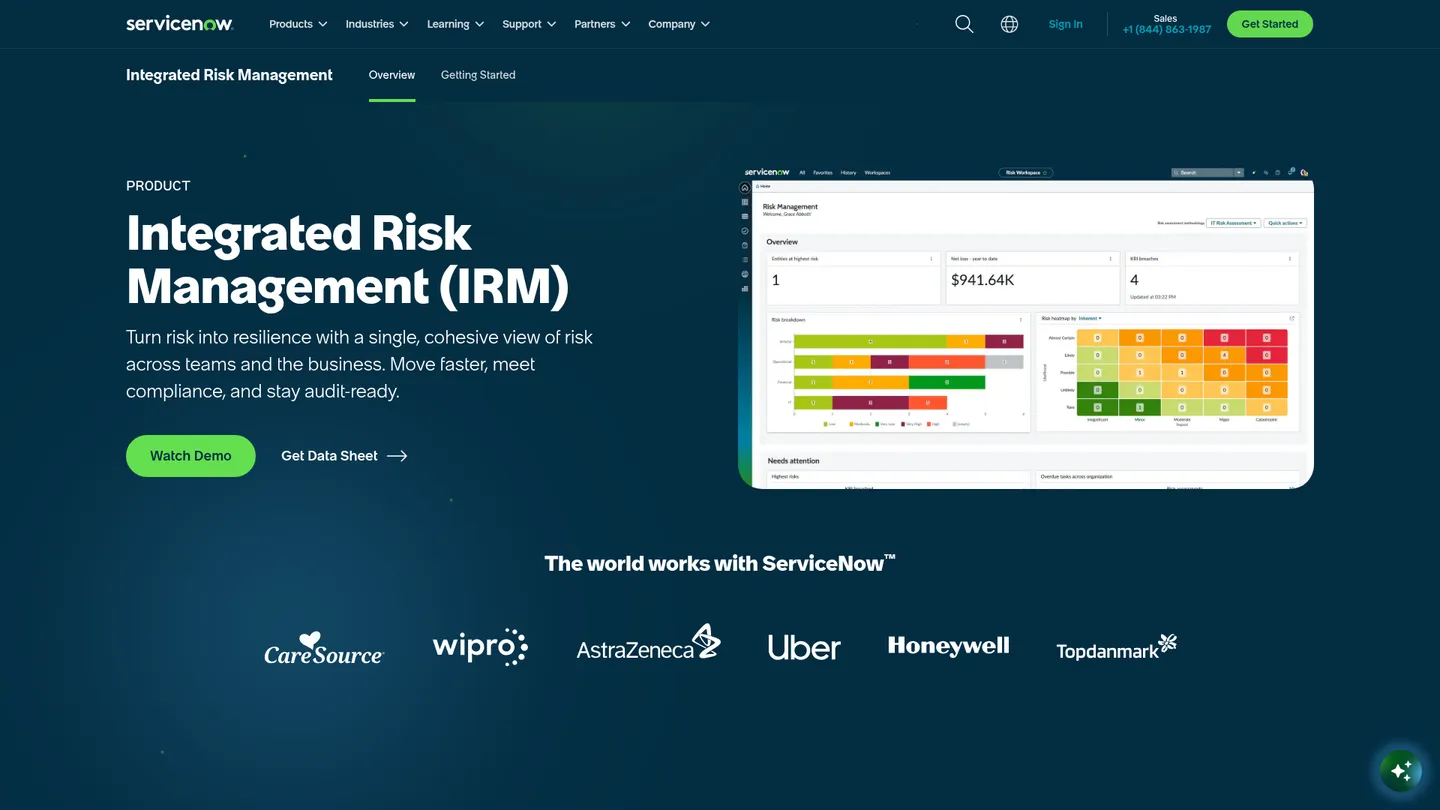
ServiceNow IRM is an enterprise governance, risk, and compliance product from ServiceNow, founded in 2004 and headquartered in Santa Clara, California. It runs on the Now Platform and connects risk, controls, compliance, audit, and remediation work across IT, cyber, and business operations.
ServiceNow Integrated Risk Management (IRM) brings risk, compliance, audit, and operational workflows into one Now Platform data model. Teams can identify and assess risks, map policies and controls, automate assessments, monitor control performance, collect audit evidence, and route issues to accountable owners. Its workflow approach links risk records to business services, assets, processes, and people, while dashboards give executives and risk teams a shared view of exposure and remediation status.
The product spans policy and compliance management, risk management, compliance case management, audit management, regulatory change management, continuous controls monitoring, operational resilience, and third-party risk use cases. AI agents and Now Assist can summarize issues, classify controls, support assessments, and recommend or route remediation. The breadth is useful for organizations already standardized on ServiceNow, but the platform is enterprise-oriented: configuration, licensing, implementation, and user adoption require specialist resources, and advanced capabilities vary by edition.
IRM is aimed at large and regulated organizations that want risk work connected to IT and business operations rather than maintained in spreadsheets or separate point tools. ServiceNow sells it through annual, quote-based subscriptions rather than publishing a standard online price. The current packaging is commonly presented as Standard, Professional, and Enterprise, with progressively broader risk and audit functionality; exact entitlements, employee counts, modules, implementation, and discounts are negotiated with ServiceNow.
Key features
Risk management
Identify, assess, prioritize, and continuously monitor enterprise, operational, technology, and business-process risks using qualitative and quantitative measures.
Policy and compliance
Centralize policy and control lifecycles, map requirements to controls, automate compliance testing, and track exceptions and remediation.
Audit management
Plan audits, coordinate requests, collect evidence, manage findings and action plans, and report on the audit lifecycle.
Regulatory change
Track emerging regulatory changes, assess impact, and assign work needed to update controls and reduce non-compliance.
Continuous controls monitoring
Use performance analytics and automated testing to detect failing controls and create issues between periodic assessments.
Compliance case management
Report, investigate, resolve, and document compliance cases, issues, and exceptions in structured workflows.
Operational resilience
Connect critical services, processes, risks, and controls to support resilience planning and coordinated remediation.
ServiceNow IRM pricing
ServiceNow does not publish a paid entry price for IRM. Pricing is negotiated and can depend on edition, employee or user scope, selected applications, contract terms, and implementation. Standard, Professional, and Enterprise are the documented package levels, with Professional and Enterprise adding progressively more advanced risk, regulatory, and audit capabilities.
| Plan | Price | What's included |
|---|---|---|
| IRM Standard | Custom | Core risk and compliance foundation, policy and compliance management, risk management, audit management, performance analytics for GRC, and the ServiceNow IRM platform. |
| IRM Professional | Custom | Standard capabilities plus predictive intelligence, advanced audit management, regulatory change management, selected use-case accelerators, continuous authorization and monitoring, and limited advanced risk functionality. |
| IRM Enterprise | Custom | Professional capabilities plus broader advanced risk functionality, risk events, automated factors and integrations, external-loss support, and expanded enterprise risk features. |
Free trial: No public self-serve free trial is listed; request a ServiceNow demonstration and quote.
Pros & cons
Pros
- Connects risk and compliance records with ServiceNow services, assets, workflows, and ownership data.
- Covers policy, risk, compliance cases, regulatory change, continuous monitoring, and audit in one platform.
- Offers strong workflow automation, dashboards, role-based views, and structured remediation tracking.
- Provides package options and accelerators for operational resilience, NIST, CIS, GDPR, and technology controls.
Cons
- Pricing and edition entitlements are quote-based, making early budget comparison difficult.
- Implementation and administration can be complex for teams without ServiceNow specialists.
- Advanced risk, audit, regulatory, and intelligence features may require higher editions or additional products.
- The broad platform can feel less intuitive than a focused GRC tool for smaller organizations.
Who is ServiceNow IRM best for?
- Large enterprises that already run core workflows on ServiceNow and want risk data connected to those workflows.
- Regulated organizations coordinating policy, controls, audit evidence, and remediation across multiple business units.
- Risk teams that need operational and IT context, including service, asset, and configuration relationships.
- Organizations willing to fund implementation and governance resources for a configurable enterprise platform.
Coverage
Integrations
Notable customers
Frequently asked questions
How much does ServiceNow IRM cost?
+
ServiceNow does not publish a standard IRM price or paid entry plan. It sells annual subscriptions on a quote basis, with the total affected by package, employee or user scope, modules, contract terms, and implementation.
How long does a ServiceNow IRM implementation take?
+
Timing depends on the number of modules, data migration, integrations, controls, and business units. A typical enterprise rollout requires discovery, configuration, testing, training, and phased adoption rather than a self-serve setup.
How does ServiceNow IRM compare with AuditBoard?
+
ServiceNow IRM is strongest when risk work must connect to ServiceNow IT, service, asset, and workflow data across the enterprise. AuditBoard is a more focused audit and compliance platform and may be simpler for organizations that do not need the broader Now Platform.
What does ServiceNow IRM integrate with?
+
IRM uses the Now Platform and can connect with ITOM, CMDB, and Integration Hub to bring operational context into risk workflows. ServiceNow materials also identify integrations or accelerators involving Thomson Reuters Regulatory Intelligence and RiskLens.
Who should use ServiceNow IRM?
+
It is designed for large and regulated organizations managing risk, compliance, audit, and operational resilience across many teams. It is particularly suitable for existing ServiceNow customers that want one workflow and data model instead of disconnected GRC tools.
Is ServiceNow IRM secure and accurate for compliance work?
+
The platform provides role-based access, centralized evidence and control records, workflow history, dashboards, and automated testing to support consistent processes. It does not make compliance decisions automatically: organizations still need to configure appropriate frameworks, validate data, and review AI-assisted outputs.
Sources
Facts and pricing verified on October 19, 2026. Vendors change pricing often, so confirm with ServiceNow IRM before buying. How we research