 Pentera
 Cobalt
 HackerOne Pentest
 Tenable Nessus
 Invicti
What is Casco?
Founded in 2025 and headquartered in San Francisco, Casco provides autonomous security testing for software teams. The company says it has raised $17M and tested software at more than 400 companies.
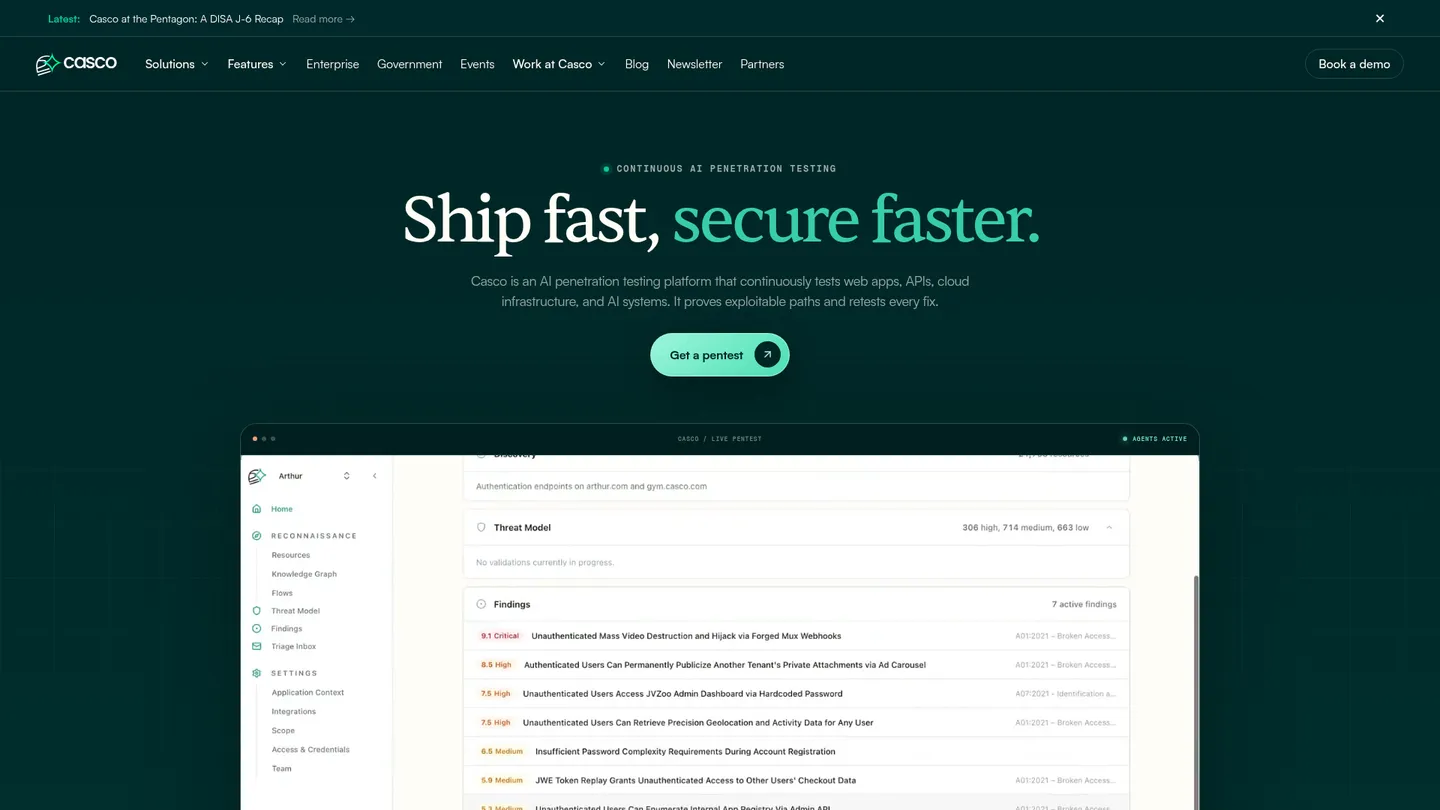
Casco is an AI penetration-testing platform that signs into approved targets, maps identities, endpoints, services, and data paths, then designs and runs adaptive attack scenarios. Its agents validate exploitable vulnerabilities rather than simply matching signatures, recording the affected resource, attack request, demonstrated impact, reproduction steps, and remediation guidance. Teams can provide black-box access or add source, cloud, architecture, documentation, and test-credential context for grey-box testing. Optional Casco Supervised adds human security-engineer review.
Coverage spans web applications, APIs, cloud infrastructure, mobile apps, browser extensions, internal and external networks, AI applications, agents, and MCP servers. Casco also ingests external security reports and scanner alerts, investigates claims, and separates validated issues from noise. Continuous testing retains application context and can replay the exact attack after a release or fix. Coverage depends on the targets, identities, workflows, tools, data, and permissions supplied, and the platform does not perform DDoS or resource-exhaustion attacks.
Casco is aimed at application-security, engineering, and security teams that ship frequently and need evidence for customers, procurement, or compliance programs. Reports support SOC 2 and ISO 27001 work, while Casco Supervised offers attestation letters and human-reviewed deliverables; the company also markets government testing through a FedRAMP Marketplace listing. Pricing is quote-based and depends on test scope and product-change frequency. Public pages provide no numerical tiers, so buyers should price automated testing and supervised review separately.
Key features
Continuous testing
Agents test approved applications and infrastructure continuously, retaining context across releases and validating fixes by replaying the original attack.
Authenticated attack mapping
Casco maps domains, endpoints, identities, roles, tenant boundaries, services, and AI interfaces to build scenario-based tests.
Exploit validation
Each confirmed finding includes reproducible attack evidence, observed impact, the affected resource, and remediation guidance.
AI agent testing
Testing covers prompt injection, tool misuse, approval bypass, sensitive-data exposure, cross-tenant access, RAG manipulation, and MCP trust failures within scope.
Report triage
Casco investigates incoming reports and scanner alerts, safely tests claims in the relevant environment, and returns a validated verdict.
Supervised pentesting
Casco Supervised combines its autonomous agent with human engineers and covers OWASP web, API, LLM, cloud, and agentic threat models.
Workflow integration
Teams can connect GitHub, AWS, Google Cloud, Buildkite, Railway, Vercel, Slack, Linear, and MCP-based workflows.
Casco pricing
Casco does not publish numerical prices or self-serve tiers. Pricing depends on scope and product-change frequency, while supervised human review is scoped separately. Terms describe a one-year subscription period with monthly automatic payment available.
| Plan | Price | What's included |
|---|---|---|
| Casco | Custom | Continuous autonomous testing, validated findings, evidence, remediation guidance, and retesting. |
| Casco Supervised | Custom | Autonomous testing plus human security-engineer review, compliance-oriented reporting, optional attestation letters, and retesting. |
Free trial: No public free trial is listed; book a demo to scope testing.
Pros & cons
Pros
- Adaptive agents test authenticated workflows and multi-step attack paths instead of only matching known patterns.
- Findings include reproduction evidence, demonstrated impact, remediation guidance, and exact-attack retesting.
- Coverage includes modern AI applications, agents, and MCP servers alongside conventional web, API, cloud, and network targets.
- Optional human review, CREST accreditation, and attestation letters support procurement and compliance requirements.
Cons
- Pricing is quote-only, with no public numerical tiers or entry price for budget comparison.
- Test quality and coverage depend on the identities, workflows, tools, data, permissions, and context provided.
- Human-supervised deliverables are an additional scoped service rather than part of every autonomous test.
- The platform is offensive testing, not a remediation service; engineering teams must fix and verify issues themselves.
Who is Casco best for?
- Application-security teams needing continuous testing instead of an annual point-in-time pentest.
- AI product teams evaluating agents, tool use, permissions, and sensitive-data boundaries.
- Fast-moving software companies needing reproducible evidence for procurement and customer security reviews.
- Government and regulated teams needing controlled scope, traceable traffic, and compliance-oriented pentest reports.
Coverage
Integrations
Notable customers
Frequently asked questions
How much does Casco cost?
+
Casco uses quote-based pricing rather than publishing dollar amounts. Cost depends on test scope and product-change frequency; Casco Supervised is scoped separately.
How does Casco work, and how quickly do results arrive?
+
Agents discover the approved attack surface, authenticate where authorized, design tests from observed context, and validate exploitable paths with reproducible evidence. Findings are delivered as validated; a human-approved report is available within five business days.
How is Casco different from a traditional scanner or annual pentest?
+
A scanner generally looks for known patterns, while an annual pentest captures one version of a product. Casco combines adaptive agents, retained context, optional human review, and exact-attack retesting after releases and fixes.
What integrations does Casco support?
+
Published integrations include GitHub, AWS, Google Cloud, Buildkite, Railway, Vercel, Slack, and Linear. Casco also exposes pentest context through MCP.
Who should buy Casco?
+
Casco is designed for security and engineering teams securing frequently changing software, cloud environments, and AI systems. It is especially relevant when customers or procurement teams require reproducible pentest evidence.
Is Casco safe and accurate enough for production testing?
+
Casco restricts activity to approved targets, accounts, time windows, and rules of engagement, with stable source IPs and request IDs. It does not perform DDoS or resource-exhaustion attacks; human verification is available when required.
Sources
Facts and pricing verified on October 19, 2026. Vendors change pricing often, so confirm with Casco before buying. How we research