 Vanta
 Drata
 Sprinto
 Hyperproof
 Thoropass
What is Secureframe?
Founded in 2020 and distributed across six hubs including San Francisco, Secureframe automates evidence collection, monitoring, risk management, and audit preparation. The company reports 200+ employees, $79M in funding, and thousands of customers.
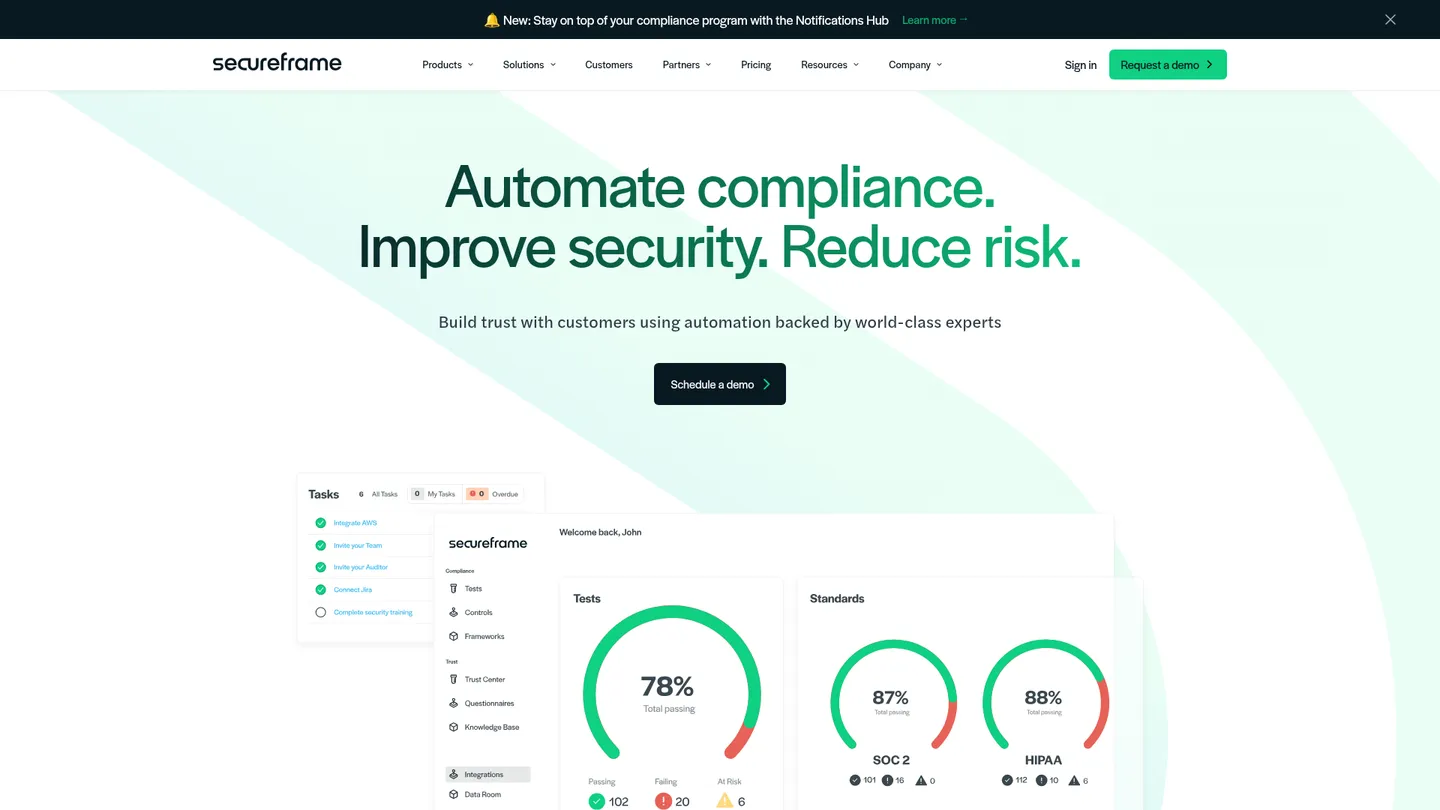
Secureframe is a cloud compliance and governance, risk, and compliance platform that connects to business, cloud, identity, and infrastructure systems. It continuously collects audit evidence, runs automated tests, monitors controls, manages policies and personnel, and organizes remediation work in a shared workspace. The platform also provides readiness reports, a trust center, security questionnaires, and support from compliance experts and former auditors.
The product covers evidence collection, continuous monitoring, policy and personnel management, asset inventories, vendor risk, access reviews, risk registers, questionnaire automation, trust centers, and custom frameworks and tests. Its packages also include CMMC-oriented capabilities such as SSPs, POA&Ms, SPRS tracking, managed CUI environments, and virtual desktops. The breadth is substantial, but implementation still requires configuring integrations, controls, evidence, and organization-specific policies.
Secureframe suits startups, growing technology companies, enterprises, and defense contractors that need repeatable compliance operations across multiple frameworks. Pricing is subscription-based and quote-led on the main pricing page. An AWS Marketplace listing gives a benchmark of $7,500 annually for platform access for up to 100 employees plus $7,500 annually for a first framework, with additional discounts possible for smaller teams and multi-framework purchases.
Key features
Evidence collection
Automatically collects audit evidence from connected business, cloud, identity, and infrastructure systems.
Continuous monitoring
Runs automated tests and monitors integrated systems for control failures and compliance gaps.
Framework management
Supports prebuilt and custom frameworks, controls, tests, and cross-framework control mapping.
Risk management
Maintains risk registers, vendor inventories, assessments, findings, scoring, and remediation workflows.
Policy management
Provides customizable policy templates, acceptance tracking, and AI-assisted policy work.
Questionnaire automation
Uses a knowledge base and AI-assisted responses for security questionnaires, RFPs, and due diligence requests.
CMMC operations
Defense includes SSP, POA&M, SPRS score tracking, CUI vendor management, and managed CUI environment capabilities.
Secureframe pricing
Secureframe presents Fundamentals, Complete, and Defense packages without public list prices on its main pricing page. AWS Marketplace lists $7,500 per year for platform access for up to 100 employees and $7,500 per year for a first framework, or $15,000 annually together. The AWS listing says fees are non-cancellable and non-refundable and that smaller teams or multi-framework buyers may receive discounts.
| Plan | Price | What's included |
|---|---|---|
| Fundamentals | Custom | Infrastructure monitoring, evidence collection, personnel management, risk management, policy management, trust center, and custom frameworks, controls, and tests. |
| Complete | Custom | Everything in Fundamentals, plus advanced third-party risk management, advanced risk management, advanced access reviews, advanced trust center, questionnaire automation, SSO and SCIM, and custom integrations. |
| Defense | Custom | Everything in Complete, plus SPRS score tracking, SSP and POA&M management, automated SSP implementation statuses, managed CUI enclave, managed virtual desktops, and CUI vendor management. |
Free trial: No free trial is listed in the supplied pricing materials.
Pros & cons
Pros
- The platform combines evidence, controls, policies, risks, vendors, personnel, and questionnaires in one workspace.
- Its integration library supports automated evidence collection across more than 300 tools.
- Framework coverage includes commercial, privacy, federal, and defense-oriented requirements.
- The Defense package adds practical CMMC workflow features including SSP, POA&M, and SPRS tracking.
Cons
- Main pricing is not publicly listed, making budget comparison difficult without a sales process.
- The broad feature set requires configuration of integrations, controls, policies, and evidence before it reflects an organization accurately.
- Some capabilities, including advanced questionnaires, SSO and SCIM, and custom integrations, are package-dependent.
- Automated collection and AI-assisted responses do not replace organization-specific remediation or audit judgment.
Who is Secureframe best for?
- Technology companies preparing for SOC 2 or ISO 27001 audits.
- Teams managing several compliance frameworks in one program.
- Organizations that need automated evidence collection across cloud and business systems.
- Defense contractors managing CMMC, SSP, POA&M, and SPRS work.
Frameworks and use cases
Integrations
Notable customers
Frequently asked questions
How much does Secureframe cost?
+
The main pricing page uses custom pricing. AWS Marketplace lists $7,500 annually for platform access for up to 100 employees and $7,500 annually for a first framework, producing a $15,000 annual benchmark before any eligible discount.
How long does Secureframe take to implement?
+
Secureframe automates evidence collection and monitoring after integrations, controls, and policies are configured. G2 lists a two-month average implementation time, while the actual schedule depends on framework scope, system complexity, and audit readiness.
How does Secureframe compare with Vanta?
+
Both platforms automate compliance evidence and monitoring across common security frameworks. Secureframe differentiates itself in the supplied materials with broad framework coverage, CMMC-focused Defense capabilities, custom testing, risk workflows, and a listed 300+ integration library.
What does Secureframe integrate with?
+
The integration catalog lists more than 300 connections. Examples include AWS, Google Cloud, Microsoft Azure, GitHub, Okta, Google Workspace, Microsoft 365, Slack, MongoDB Atlas, and 1Password.
Who is Secureframe for?
+
It is designed for organizations building or maintaining security and privacy compliance programs, including startups, growing technology companies, enterprises, and defense contractors. Its capabilities cover SOC 2, ISO 27001, HIPAA, PCI DSS, GDPR, NIST, FedRAMP, and CMMC-related work.
Does Secureframe improve compliance accuracy and security?
+
Secureframe continuously collects evidence, runs automated tests, monitors controls, and provides audit trails and remediation workflows. Those functions improve visibility and reduce manual work, but teams remain responsible for correct scoping, configuration, remediation, and the accuracy of submitted evidence.
Sources
Facts and pricing verified on October 19, 2026. Vendors change pricing often, so confirm with Secureframe before buying. How we research