
 Credo AI
 OneTrust
 IBM OpenPages
 ServiceNow IRM
 MetricStream
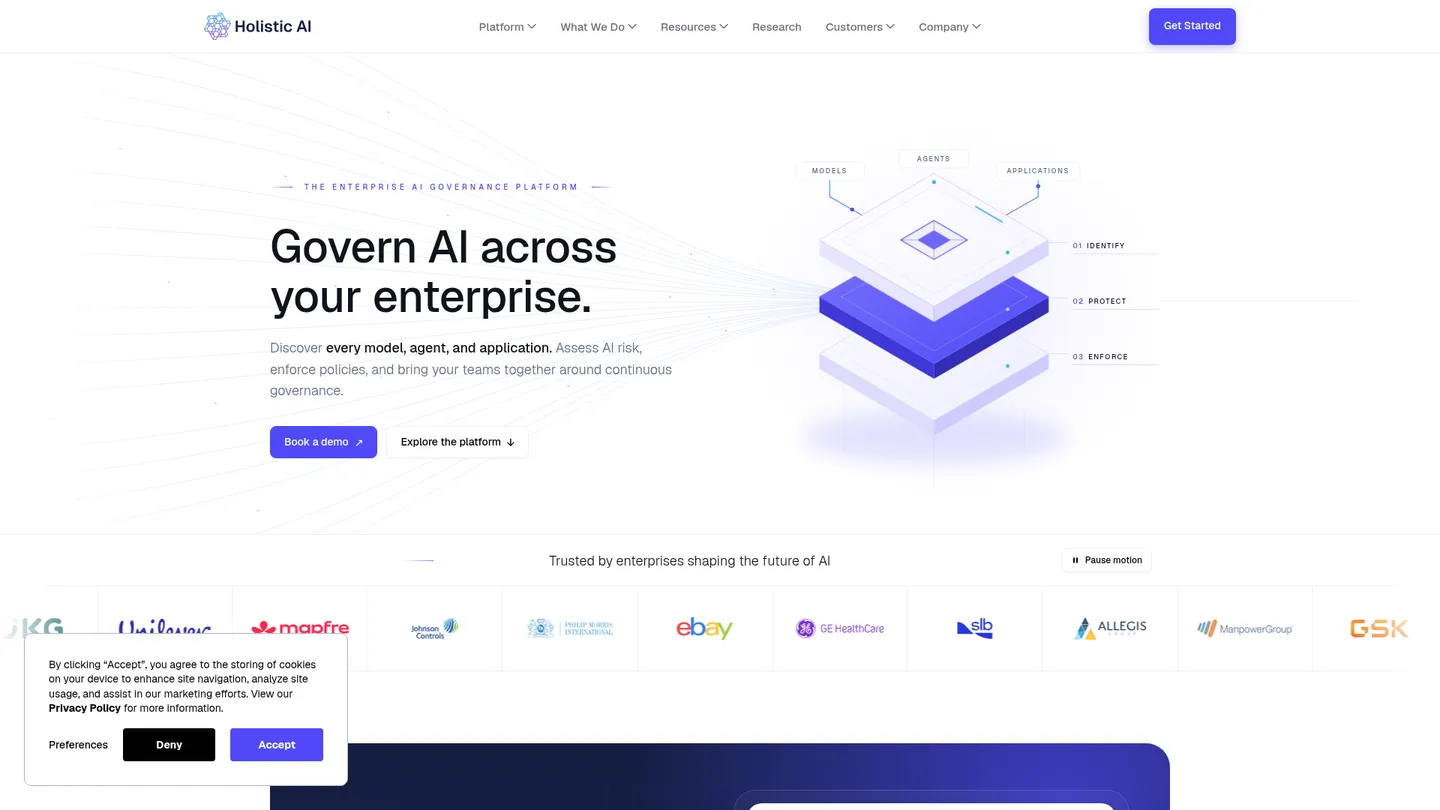
What is Holistic AI?
Founded in 2020 and headquartered in San Francisco, Holistic AI provides enterprise AI governance across models, agents, applications, and embedded tools. The company lists 85 employees and offices in San Francisco and London.
Holistic AI is an enterprise governance platform that creates a live inventory of AI models, agents, datasets, APIs, pipelines, and applications. Read-only connections scan cloud, code, data, ML, LLM, and SaaS environments to surface shadow AI, classify assets, assign ownership, track lifecycle, and map dependencies. Teams can then assess AI systems, route approvals, and maintain a shared record of risk, controls, and evidence across the organization.
The platform combines discovery with testing, monitoring, regulatory mapping, policy workflows, and runtime enforcement. It supports bias, robustness, privacy, security, explainability, performance, and operational-risk assessment, then maps findings to EU AI Act, NIST AI RMF, ISO 42001, NYC Local Law 144, internal policies, and custom requirements. Its breadth suits complex portfolios, but connector coverage, technical setup, and policy design still shape inventory completeness and implementation effort.
Holistic AI is aimed at enterprises, regulated organizations, governments, and teams responsible for AI risk across legal, compliance, security, data science, and business functions. The vendor does not publish self-serve rates, seat bands, or module prices; commercial terms are quote-based and typically depend on AI inventory size, selected capabilities, integrations, frameworks, and services. Buyers should request a scoped annual quote rather than assume a simple per-seat plan.
Key features
AI discovery and inventory
Continuously discover and catalog models, agents, datasets, endpoints, pipelines, APIs, and applications across cloud, code, and SaaS.
AI risk assessment
Assess bias, robustness, privacy, security, explainability, efficacy, and operational risks across AI systems.
Regulatory alignment
Map AI systems to requirements and controls for the EU AI Act, NIST AI RMF, ISO 42001, NYC Local Law 144, and custom frameworks.
Policy enforcement
Turn governance policies into controls, approval gates, deployment blocks, escalations, and human-oversight workflows.
Guardian agents
Use runtime enforcement agents to block, redirect, pause, or escalate unsafe or non-compliant AI actions.
Audit evidence
Maintain version history, audit trails, compliance documentation, remediation records, and regulator-ready reports.
Governance workflows
Coordinate intake, risk classification, sign-offs, notifications, mitigation tasks, and accountability across teams.
Holistic AI pricing
Holistic AI uses a custom enterprise quote rather than public platform rates. Buyers scope discovery, governance, testing, integrations and implementation with sales.
| Plan | Price | What's included |
|---|---|---|
| Enterprise platform | Custom quote | AI discovery, inventory, risk assessment, regulatory alignment, policy workflows, enforcement, integrations, and audit evidence; exact scope is quote-defined |
Free trial: No public free trial is listed.
Pros & cons
Pros
- Combines AI discovery, inventory, assessment, compliance mapping, and enforcement in one platform.
- Read-only connectors can surface models, agents, and shadow AI across common enterprise environments.
- Framework workflows produce structured evidence for major AI regulations and standards.
- Runtime Guardian Agents can block, redirect, or escalate unsafe actions instead of merely reporting them.
Cons
- Public pricing is unavailable, so buyers must complete a sales process before comparing costs.
- Broad platform scope can require specialist governance ownership and substantial policy configuration.
- Inventory quality depends on enabled connectors and the completeness of the organization’s technology estate.
- Independent software-directory review coverage remains limited compared with established GRC platforms.
Who is Holistic AI best for?
- Enterprises managing large and varied AI portfolios across cloud, code, and SaaS.
- Regulated teams needing documented alignment with the EU AI Act, NIST AI RMF, or ISO 42001.
- Security, legal, risk, and data teams that need one inventory and shared approval workflows.
- Organizations requiring technical bias, robustness, privacy, and security assessments before or after deployment.
Frameworks and use cases
Integrations
Notable customers
Frequently asked questions
How much does Holistic AI cost?
+
The vendor does not publish list prices or self-serve tiers. Pricing is custom and can vary with governed AI assets, selected modules, integrations, frameworks, and implementation requirements.
How long does implementation take?
+
Holistic AI does not publish a standard implementation timeline. The practical effort depends on connector coverage, AI inventory complexity, risk taxonomy, workflow configuration, and whether runtime enforcement requires additional instrumentation.
How does Holistic AI compare with OneTrust?
+
Holistic AI is centered specifically on AI discovery, technical risk testing, AI-framework mapping, and runtime controls. OneTrust is a broader privacy, risk, and compliance suite, so the better fit depends on whether AI governance or a wider GRC program is the primary requirement.
What integrations does Holistic AI support?
+
The platform lists connections for AWS, Azure, Google Cloud, GitHub, GitLab, Bitbucket, Databricks, Snowflake, SageMaker, OpenAI, Anthropic, ServiceNow, Confluence, and SharePoint. It also describes REST APIs, webhooks, SDKs, and custom connectors.
Who is Holistic AI for?
+
It is designed for enterprises, regulated organizations, governments, and cross-functional teams governing AI at scale. Typical stakeholders include legal, compliance, security, risk, data science, engineering, and business owners.
How does it support security and accuracy?
+
The platform assesses security, privacy, robustness, bias, explainability, efficacy, and operational risk, while maintaining ownership, lifecycle records, evidence, and audit trails. Assessment quality still depends on the systems connected, data supplied, chosen tests, and governance policies configured by the buyer.
Sources
Facts and pricing verified on October 19, 2026. Vendors change pricing often, so confirm with Holistic AI before buying. How we research