
 QuickBooks
 Puzzle
 Digits
 Zeni
 Numeric
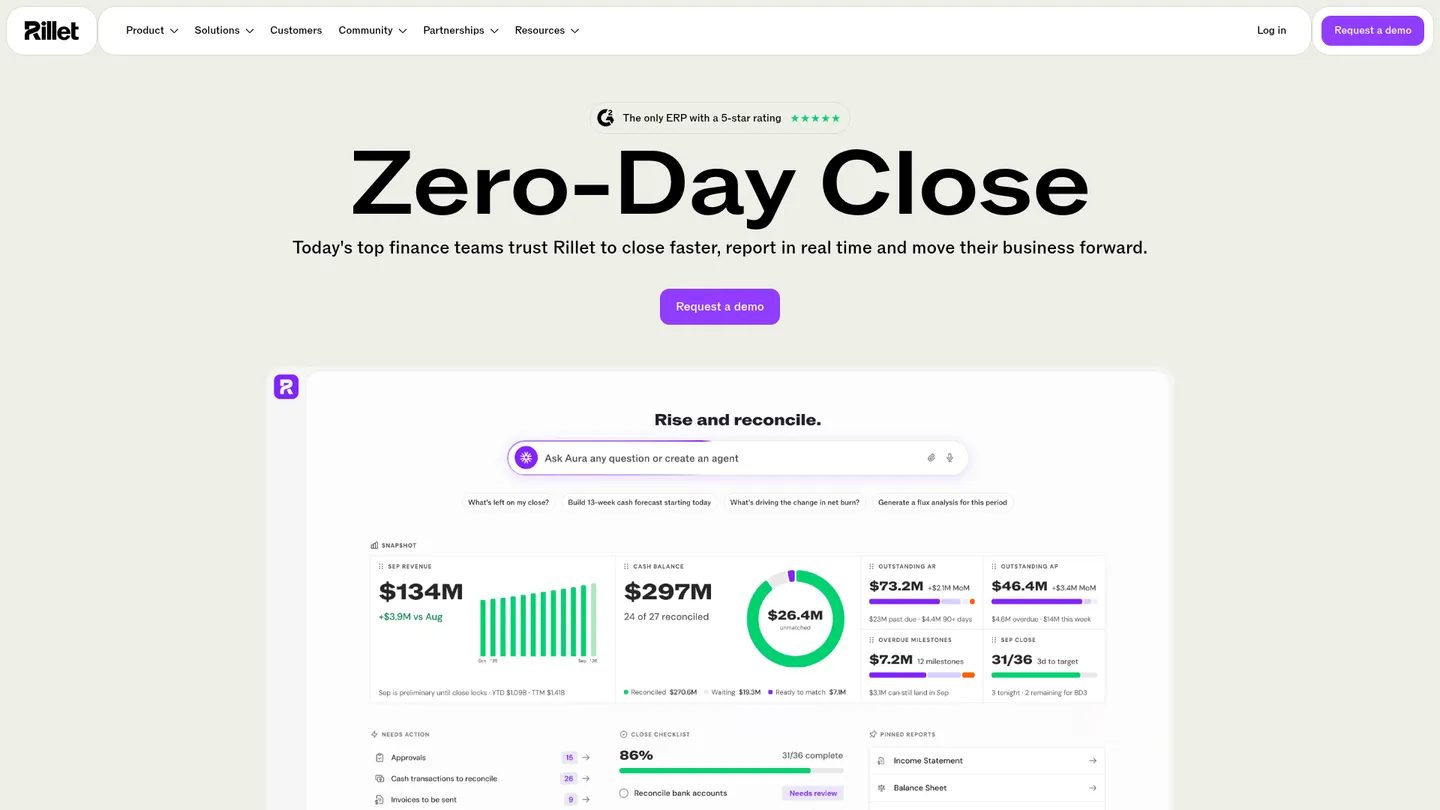
What is Rillet?
Founded in 2021 and headquartered in New York, Rillet is an AI-native ERP for modern finance teams. It reports 800+ customers in 70+ countries, more than $200M raised, and 12,000+ integrations.
Rillet is an AI-native ERP that combines a real-time general ledger, continuous-close workflows, accounts payable and receivable, revenue recognition, reporting, and AI agents in one system. Aura can answer finance questions and perform actions such as creating journal entries, generating income statements, and looking up vendor history. Native connections bring CRM, payroll, payments, expense, and tax data into the accounting workflow, reducing re-entry while preserving approval controls and audit trails.
The product covers automated GL, multi-entity consolidation, bank reconciliation, close management, SaaS reporting, advanced revenue recognition, contract billing, and flexible GAAP reporting. Its October 2026 release added Make, Payhawk, richer Salesforce and HubSpot mapping, and faster Aura actions. Avalara integration calculates tax on invoices and credit memos, supports estimated tax on future invoices, and allows edits followed by batch commits. Public materials do not establish every ERP edge case or a universal implementation limit.
Rillet is aimed at growing SaaS and other high-growth companies whose finance teams have outgrown entry-level accounting tools, including public companies and multi-entity operators. The company says 800+ finance teams use it across 70+ countries, while named customers include Mercor, Function Health, Temporal, Jump, and VSee. Pricing is quote-based: Rillet says it prices by features used and organizational complexity rather than seats or revenue. No public dollar tiers or standard free trial are verified.
Rillet news
Avalara for Rillet brings sales tax into the ERP
Sales tax calculation, 50-state nexus tracking and return filing now run directly inside Rillet's invoicing, which suits SaaS companies billing across state lines.
Key features
AI finance agents
Aura answers finance questions and can create or post journal entries, generate statements, and look up vendor activity.
Automated general ledger
The real-time ledger automates recurring accounting workflows while retaining approvals and audit history.
Revenue recognition
Advanced revenue recognition supports SaaS contracts and ASC 606-oriented workflows.
Multi-entity accounting
Consolidation, intercompany entries, eliminations, and multicurrency workflows support complex corporate structures.
Accounts receivable
Contract, invoicing, collections, and scheduled-invoice workflows connect billing activity to the ledger.
Sales tax automation
Avalara calculates tax on Rillet invoices and credit memos, with estimated future tax and batch commitment.
Close and reporting
Close management, bank reconciliation, flexible GAAP reporting, and SaaS metrics organize month-end and management reporting.
Rillet pricing
Starting price: Custom (as of Nov 2026)
Rillet states that pricing is based on features used and organizational complexity, not seats or revenue. Public materials do not list fixed dollar amounts or standard tiers. Implementation is positioned for a scoped sales process rather than self-serve checkout.
| Plan | Price | What's included |
|---|---|---|
| Custom | Quote-based | Modules, integrations, entities, controls, and implementation scoped to the organization. |
Free trial: Request a demo and quote.
Pros & cons
Pros
- Combines GL, close, billing, revenue recognition, and AI actions in one platform.
- Avalara calculates tax on invoices and credit memos and supports future-invoice estimates.
- Pricing is not seat-based, and Rillet says there is no limit on seats.
- SOC 1 Type II and SOC 2 Type II audits, encryption, logging, and monitoring address enterprise controls.
Cons
- Pricing is custom, with no public dollar tiers for budget comparison.
- Implementation and module scope require a sales-led evaluation rather than self-serve purchase.
- The broad integration count does not mean every connection is native or equally deep.
- G2 feedback praises usability but notes that some integrations could be improved.
Who is Rillet best for?
- SaaS companies needing revenue recognition and subscription-aware accounting.
- Lean finance teams managing multiple entities, currencies, and intercompany activity.
- Companies replacing QuickBooks or legacy ERP workflows with a connected real-time ledger.
- Teams wanting embedded sales-tax calculation through Avalara rather than spreadsheet exports.
Coverage
Integrations
Notable customers
Frequently asked questions
How much does Rillet cost?
+
Rillet uses quote-based pricing based on features used and organizational complexity, rather than seats or revenue. It does not publish standard dollar tiers, so buyers need a scoped quote.
How does Rillet work and how long does implementation take?
+
Rillet centralizes the ledger, close, billing, payables, receivables, revenue recognition, reporting, and AI actions, then connects the surrounding finance stack. Rillet’s published customer material cites implementations as fast as four weeks, but timing depends on entities, integrations, data migration, and controls.
How does Rillet compare with NetSuite?
+
Rillet targets modern, high-growth finance teams with a real-time ledger, SaaS revenue workflows, native integrations, and AI actions. NetSuite is a broader legacy ERP with a larger ecosystem; Rillet is the more focused option when rapid SaaS accounting automation matters more than maximum historical breadth.
Does Rillet integrate with Avalara and other finance tools?
+
Yes. Avalara calculates tax on every invoice and credit memo, shows estimated tax on scheduled invoices, and supports post-send edits and batch commits. Other published integrations include Stripe, Salesforce, HubSpot, Ramp, Rippling, Make, and Payhawk.
Who is Rillet for?
+
Rillet is designed for scaling SaaS and other high-growth companies, especially teams with complex revenue recognition, multiple entities, and lean accounting staff. Its published customer base includes public companies and technology, healthcare, logistics, and other growth businesses.
Is Rillet secure and accurate for accounting and tax work?
+
Rillet says it undergoes annual SOC 1 Type II and SOC 2 Type II audits, uses AES-256 at rest and TLS 1.2+ in transit, and logs AI actions. Avalara supplies the tax engine and jurisdictional content; buyers still need to configure product taxability, nexus, exemptions, and filing settings correctly.
Sources
Facts and pricing verified on November 1, 2026. Vendors change pricing often, so confirm with Rillet before buying. How we research
- Rillet About
- Rillet Avalara integration
- Avalara partnership announcement
- Avalara for Rillet
- Rillet security
- Rillet October 2026 updates
- Rillet Series C
- G2 reviews
Work at Rillet or spot something out of date? Suggest a correction. We check every report against a public source and update the page, usually within a few days.