
 Vanta
 Drata
 Secureframe
 Hyperproof
 Optro
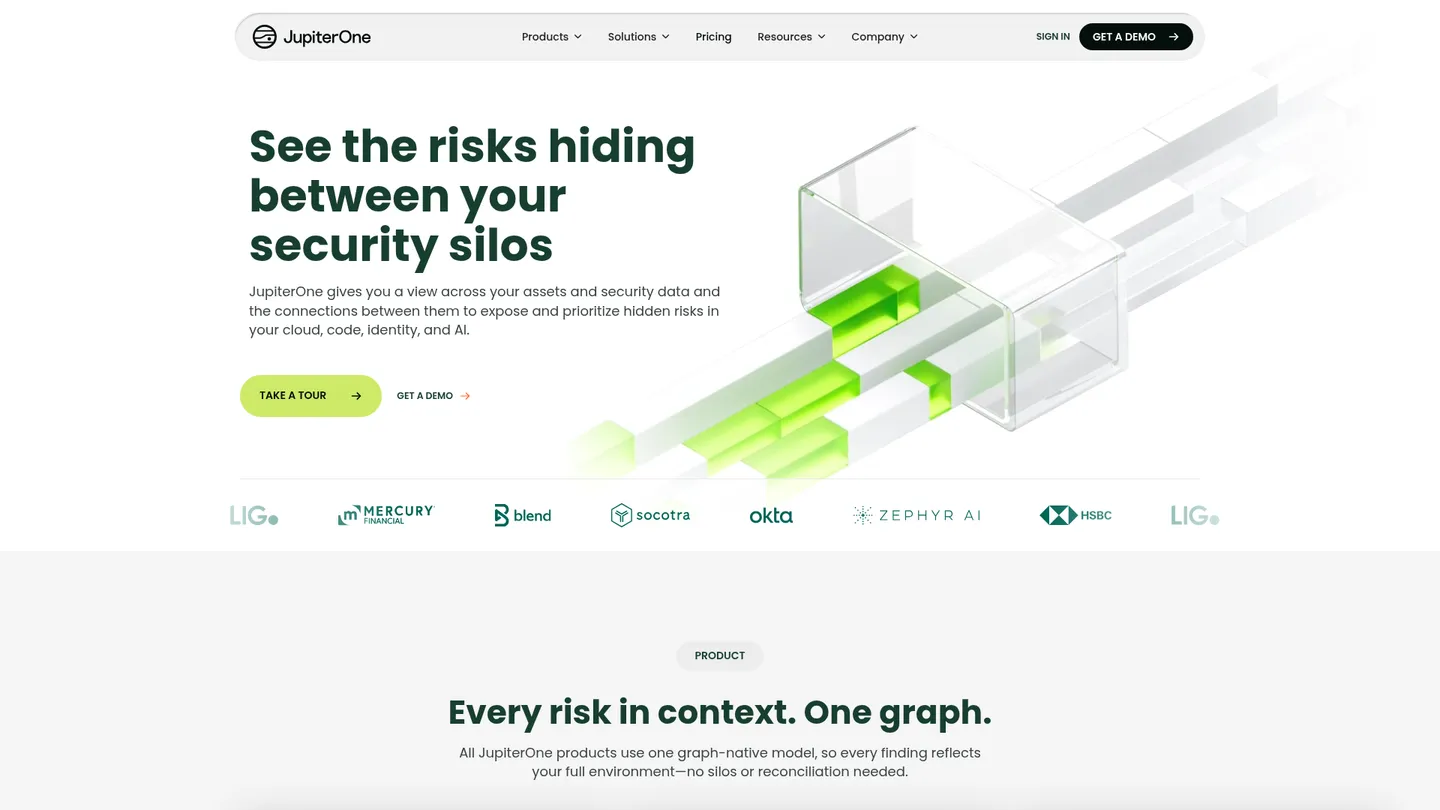
What is JupiterOne?
JupiterOne is a graph-native security and compliance platform that connects assets, vulnerabilities and controls across cloud, code, identity and AI. It offers asset visibility, attack surface management, vulnerability prioritization and continuous controls monitoring for mid-market and enterprise security teams.
JupiterOne builds a continuously updated graph of assets and their relationships across cloud infrastructure, devices, identities, code, SaaS and AI. Agentless, API-based integrations collect data into one queryable system, where teams can use J1QL or natural-language queries to investigate exposure, trace attack paths, understand blast radius and connect findings to the assets that matter most.
The platform combines AI attack surface management, unified vulnerability management and continuous controls monitoring. It can deduplicate findings, prioritize vulnerabilities by reachability and business context, route issues to owners, and test controls against live technical data. Its breadth is strongest in cloud-forward and connected environments; the supplied materials identify limited support for unauthenticated scanning of unmanaged network segments and OT/IoT-heavy environments.
JupiterOne is aimed at CISOs, security architects, SecOps teams and compliance leaders at mid-market and enterprise organizations. Pricing is primarily annual and scales by ingested data points, while vulnerability management can be priced by findings and continuous controls monitoring uses existing datapoints. Public pricing lists a $25,000 annual entry tier, with higher capacities and custom arrangements available.
Key features
Asset graph
Maps cloud, code, identity, endpoint, SaaS and AI assets with their relationships in a continuously updated graph.
Attack surface management
Discovers approved, shadow and connected assets to expose attack paths and hidden risk across the environment.
Vulnerability prioritization
Deduplicates findings and prioritizes them by reachability, exploit paths, ownership and proximity to critical assets.
Continuous controls monitoring
Tests controls against live technical data and maps one control to frameworks including SOC 2, DORA and CIS.
Compliance evidence
Automates evidence collection and continuous monitoring for benchmarks including PCI-DSS, SOC 2, FedRAMP, ISO 27001 and CIS.
Security investigation
Uses J1QL and natural-language queries to investigate assets, relationships, blast radius and control context.
Agentless integrations
Collects data through read-only APIs from more than 200 third-party applications and more than 80 AWS-native services.
JupiterOne pricing
JupiterOne prices its foundation by datapoint volume and subscription length. The official pricing page lists $25,000 per 12 months for the smallest published tier, $50,000 for up to 200,000 datapoints and $100,000 for up to 400,000 datapoints; AWS Marketplace also lists a $25,000 annual entry tier and custom private offers. Vendr reports a $59,160 median annual buyer payment across 33 purchases, which is a benchmark rather than a published plan price.
| Plan | Price | What's included |
|---|---|---|
| Small-Market | $25,000/yr | Published annual tier for the smallest environment; capacity is described as up to 200,000 datapoints in the supplied pricing materials. |
| Mid-Market | $50,000/yr | Up to 200,000 datapoints for 12 months, according to the official pricing page. |
| Enterprise | $100,000/yr | Up to 400,000 datapoints for 12 months, according to the official pricing page. |
| Custom | Custom | More than 1 million datapoints or a tailored arrangement through sales or an AWS Marketplace private offer. |
Free trial: A free cloud-savings analysis includes trial access to JupiterOne; a free community tier was also offered in company materials.
Pros & cons
Pros
- Graph relationships connect asset, identity, vulnerability and compliance context in one view.
- More than 200 integrations support broad cloud, security, identity, development and ITSM coverage.
- Continuous controls monitoring tests control effectiveness against live asset data.
- Annual datapoint pricing can consolidate several security and compliance use cases into one platform.
Cons
- The published entry price of $25,000 per year puts the platform above lightweight compliance tools.
- Pricing becomes less predictable as asset volume and connected data grow.
- The product is a weaker fit for unauthenticated scanning of unmanaged network segments and OT/IoT-heavy environments.
- J1QL, entity naming and the breadth of features can create a learning curve for new users.
Who is JupiterOne best for?
- Cloud-forward security teams that need asset relationships and risk context rather than a flat inventory.
- Compliance leaders who want control testing and evidence tied to live technical data.
- Enterprises consolidating asset visibility, vulnerability management and controls monitoring.
- Teams investigating attack paths, ownership and blast radius across connected environments.
Frameworks and use cases
Integrations
Notable customers
Frequently asked questions
How much does JupiterOne cost?
+
The official pricing page lists annual pricing starting at $25,000 for the smallest published tier. Pricing scales with datapoints and subscription length, while some modules use findings or existing datapoints; Vendr reports a $59,160 median annual buyer payment across 33 purchases.
How long does JupiterOne take to set up and how does it work?
+
JupiterOne connects cloud, security, identity, code and business tools through agentless, API-based integrations. The supplied materials describe connecting an environment in a few clicks and a 30-minute cloud-savings analysis, while full deployment time depends on integrations and environment scope.
How does JupiterOne compare with Vanta?
+
JupiterOne combines compliance monitoring with a graph of assets, relationships, vulnerabilities and attack paths. Vanta is a closer fit when the primary requirement is streamlined compliance automation, while JupiterOne is aimed at teams that also need connected asset visibility and technical control validation.
Which integrations does JupiterOne support?
+
JupiterOne lists more than 200 integrations. Named examples include AWS, Azure, GitHub, Jira, Slack, Okta, ServiceNow and SentinelOne, with coverage spanning cloud infrastructure, identity, code management, endpoint security and ITSM.
Who is JupiterOne for?
+
The platform is designed for CISOs, security architects, SecOps teams and compliance leaders. Its strongest stated fit is cloud-forward mid-market and enterprise organizations consolidating asset visibility, vulnerability management and continuous controls monitoring.
How accurate is JupiterOne's security and compliance data?
+
JupiterOne uses read-only APIs and continuously updated asset relationships to connect findings and controls to live technical data. An AWS Marketplace review described the data as reliable but noted that some governance data could require reruns to become current, so teams should validate refresh behavior for their integrations.
Sources
Facts and pricing verified on October 19, 2026. Vendors change pricing often, so confirm with JupiterOne before buying. How we research