
 OneTrust
 Archer
 Optro
 MetricStream
 LogicGate Risk Cloud
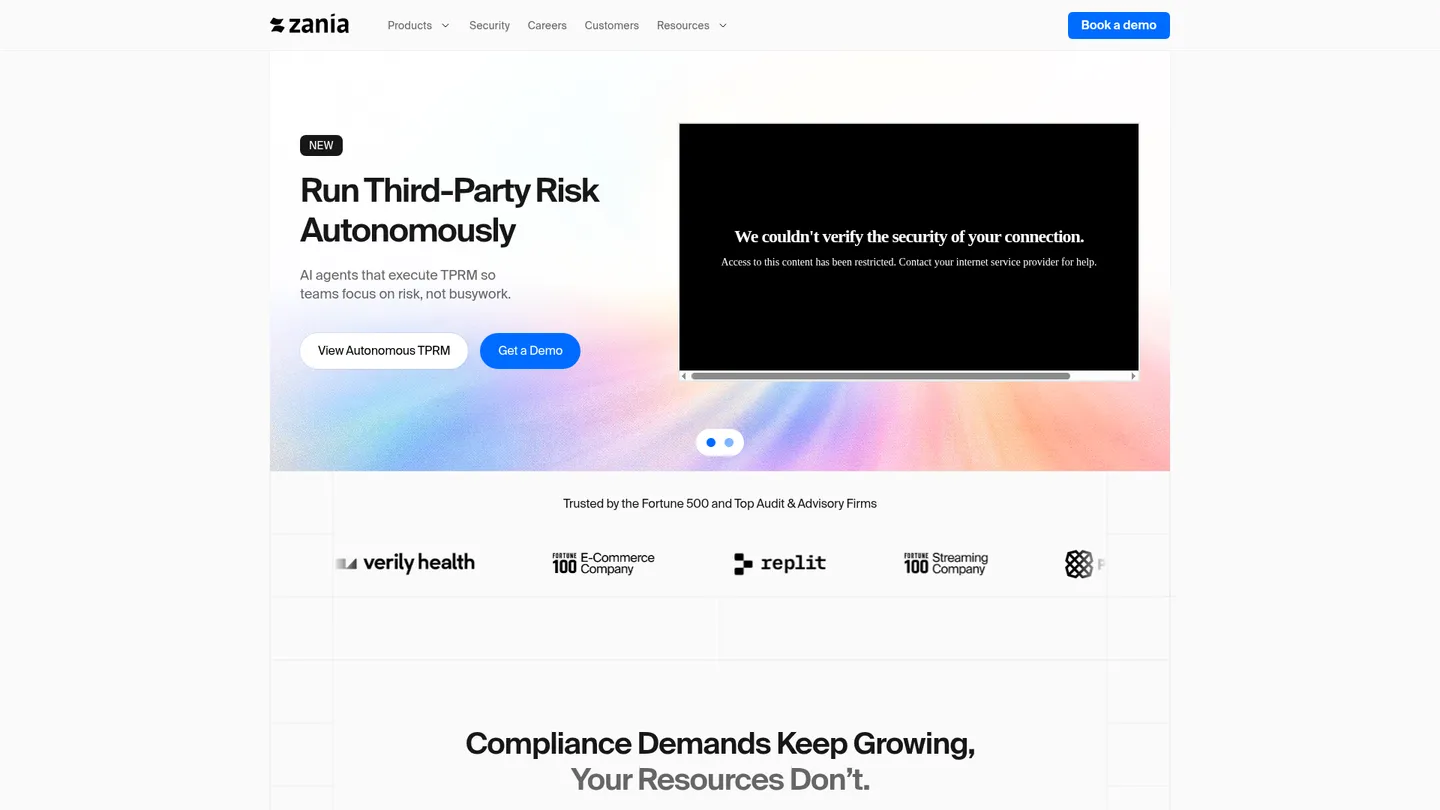
What is Zania?
Founded in 2023 and headquartered in Palo Alto, Zania is an enterprise GRC platform that uses AI agents to execute risk and compliance work. The company raised an $18 million Series A in 2025 and serves enterprises, audit firms and advisory practices.
Zania is an agentic GRC platform for teams that need more than dashboards and task tracking. Its AI agents collect evidence, test controls, assess vendors, answer security questionnaires, identify gaps and route remediation, while people set policy, approve decisions and govern exceptions. Outputs include source references, evidence trails and confidence scores, giving reviewers context for each conclusion. The platform supports both third-party and internal risk programs alongside continuous compliance workflows.
The feature set spans vendor intake and tiering, evidence collection and validation, questionnaire review, breach and supply-chain analysis, continuous monitoring, reassessment triggers, risk registers, quantitative or qualitative internal-risk analysis, controls testing, policy workflows and audit-ready reporting. Zania maps controls across SOC 2, ISO 27001, HIPAA, GDPR, PCI DSS and ISO 42001. Its autonomous approach still requires human review for approvals and exceptions, and public materials do not provide self-serve onboarding or detailed plan limits.
Zania is aimed at enterprise security, compliance, risk and audit teams, as well as audit and advisory firms delivering assessments for clients. Public customer references include Plaid, Grant Thornton, Compunnel, Stanford University and KPMG. Pricing is enterprise, quote-based and shaped by vendor volume, assessment frequency, program scope and integrations; there are no per-assessment fees. Zania offers guided demos and proof-of-concept engagements rather than a public free trial or free tier.
Key features
Third-party risk
Automates vendor intake, risk tiering, evidence review, follow-ups, continuous monitoring and reassessments with human approval controls.
Compliance automation
Maps controls, collects evidence continuously, tests design and operating effectiveness, identifies gaps and supports remediation across multiple frameworks.
Internal risk
Builds a risk register and produces qualitative or quantitative assessments using business context, evidence and external intelligence.
Controls testing
Tests controls and provides source-linked findings, confidence scores and recommendations for addressing weaknesses.
Security questionnaires
Uses organizational security context to draft tailored responses to incoming vendor questionnaires for reviewer approval.
Remediation workflows
Prioritizes issues, routes work to owners, follows up on open actions and maintains an auditable activity trail.
Audit-ready reporting
Preserves evidence citations, reasoning and historical assessments so teams can explain decisions during audits and reviews.
Zania pricing
Zania sells an enterprise plan priced by vendor volume, assessment frequency, program scope and implementation integrations. The plan includes third-party and internal risk, questionnaire automation, continuous monitoring, controls testing, unlimited reviewer seats, human approval workflows and audit-ready reporting. The company states there are no per-assessment fees and that supported frameworks are included regardless of program scope.
| Plan | Price | What's included |
|---|---|---|
| Enterprise | Custom quote | Third-party and vendor risk assessments, security questionnaire automation, continuous monitoring, reassessment triggers, controls testing, compliance management, unlimited reviewer seats, human approval workflows, audit-ready reporting, implementation and onboarding support. |
Free trial: No public free trial; guided demos and proof-of-concept engagements are available.
Pros & cons
Pros
- Automates vendor intake, evidence review, follow-ups and reassessments across the TPRM lifecycle.
- Combines third-party risk, internal risk and compliance automation in one platform.
- Links findings to sources, evidence and confidence scores for reviewable audit context.
- Supports SAML SSO through Okta, Azure AD and Google and uses private model hosting in Microsoft Azure.
Cons
- Pricing is custom and no public entry price or self-serve tier is available.
- The product is positioned for enterprise programs rather than small teams seeking lightweight onboarding.
- AI-generated assessments still require human approval for decisions, exceptions and remediation.
- Public materials describe integrations broadly but do not publish a complete connector catalog or detailed limits.
Who is Zania best for?
- Enterprise GRC teams automating vendor assessments and compliance evidence work.
- Audit and advisory firms delivering repeatable, evidence-cited risk and controls engagements.
- Organizations running multiple frameworks that want shared control mappings and continuous monitoring.
- Security teams that need human-governed AI execution rather than another passive risk dashboard.
Frameworks and use cases
Integrations
Notable customers
Frequently asked questions
How much does Zania cost?
+
Zania uses custom enterprise pricing based on vendor volume, assessment frequency, program scope and integrations. The company says there are no per-assessment fees, but it does not publish an entry price or standard seat rate.
How does Zania work and how long does implementation take?
+
Agents collect evidence, test controls, assess vendors and route remediation while staff approve decisions and exceptions. Implementation time varies with vendor-program size, existing processes and integrations; Zania offers onboarding support but does not publish a standard timeline.
How does Zania compare with OneTrust?
+
OneTrust is a broad governance, privacy and risk suite centered on configurable management workflows, while Zania emphasizes AI agents that execute assessment and evidence work. Zania is the more automation-led option for teams prioritizing source-cited vendor reviews and continuous control testing; buyers needing OneTrust’s broader privacy portfolio should compare scope carefully.
What integrations does Zania support?
+
Zania documents integrations with ServiceNow, Jira, identity providers and collaboration platforms through APIs and webhooks. Its security page specifically names SAML SSO for Okta, Microsoft Azure AD and Google, while the third-party-risk workflow can connect with existing GRC, procurement, ticketing and identity systems.
Who is Zania for?
+
Zania targets enterprise security, risk, compliance and audit teams, plus audit and advisory firms serving clients. Public customer references include Plaid, Grant Thornton, Compunnel, Stanford University and KPMG.
Is Zania secure and accurate enough for compliance work?
+
Zania states that it is SOC 2 Type 2 compliant, uses isolated private model infrastructure in Microsoft Azure and does not train models on customer data. Its compliance materials report 94%+ control-test accuracy, while human approval workflows, source citations, confidence scores and audit trails provide review controls.
Sources
Facts and pricing verified on October 19, 2026. Vendors change pricing often, so confirm with Zania before buying. How we research