 MetricStream
 LogicGate Risk Cloud
 Hyperproof
 Workiva
 OneTrust
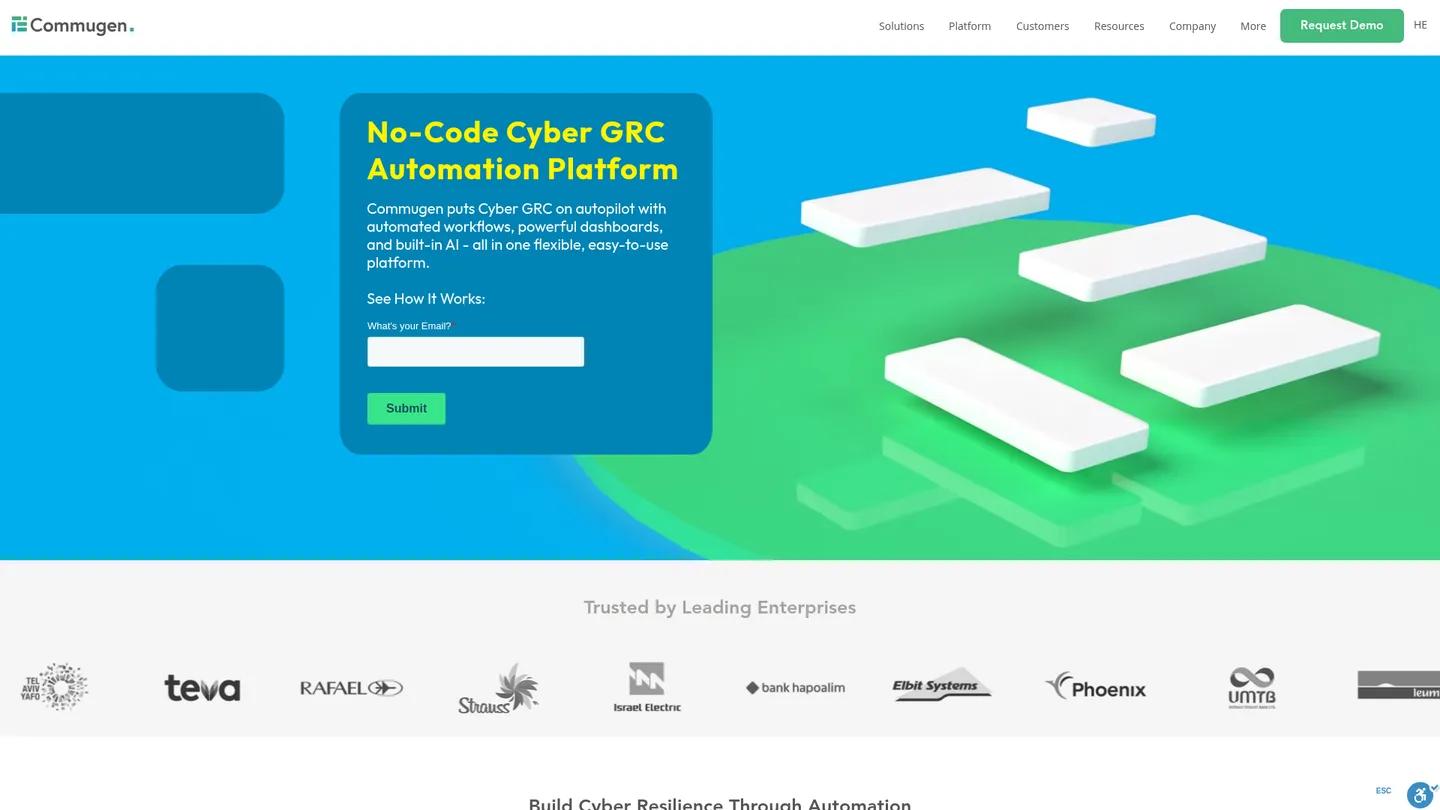
What is Commugen?
Founded in 1999 and headquartered in London, Commugen is a privately held cyber GRC software company with more than 100 enterprise customers. Its cloud and on-premise no-code platform combines configurable workflows, risk management, compliance operations, dashboards and embedded AI agents.
Commugen is a no-code cyber governance, risk and compliance platform for organizations that need to operationalize security programs without building every workflow in code. Teams can model data with drag-and-drop tools, connect records across models, define business-rule automations, and present results through dashboards and reports. The platform supports cyber risk, compliance, vulnerabilities, assets, suppliers, policies and audit work, while its permissions, version control, alerts, search and REST API support day-to-day governance.
The product spans cybersecurity compliance automation, cyber risk quantification, risk management, IT asset management, penetration-test and vulnerability management, access rights, supply-chain risk, business continuity, privacy, security training and GRC. Its AI-agent portfolio, launched October 27, 2026, reviews evidence, maps controls, drafts policies, analyzes audit and penetration-test reports, recommends mitigations and creates assigned tasks. AI outputs remain reviewable rather than autonomous decisions, and the company does not publish a self-serve feature comparison or public price list.
Commugen is aimed at enterprise security, GRC, compliance, risk, audit, procurement and IT teams, including organizations with complex frameworks or bespoke operating models. The company says it serves more than 100 leading enterprises and offers SaaS and on-premise deployments. Pricing is quote-based: the AI agents are add-ons to the cyber GRC platform, while public pages direct prospects to contact the company rather than listing tiers, minimum seats or a free trial.
Commugen news
Commugen launches AI agents for cyber GRC
Agents embedded in the no-code platform review evidence, map controls, draft policies and turn findings into tasks across third-party risk, policy, vulnerability, risk, internal audit and contracts, sold as add-ons.
Key features
No-code data modeling
Drag-and-drop data models can be adapted to changing regulations and business requirements without programming.
Workflow automation
Business rules automate actions across related data models, including approvals, reminders, escalations and operational processes.
Risk and compliance
Teams can manage risk assessments, control relationships, compliance operations, audit plans and continuous compliance workflows.
AI evidence analysis
AI reviews supplier questionnaires and evidence, identifies gaps or inconsistencies, and explains assessment scores.
Policy and control mapping
AI can draft policies from controls, derive controls from policies and connect findings to controls with explanations.
Vulnerability remediation
The platform turns penetration-test findings and vulnerabilities into structured remediation guidance, prioritized controls and assignable tasks.
Dashboards and reporting
Configurable dashboards, reports, alerts, search, permissions and version control provide role-specific oversight and audit traceability.
Commugen pricing
Starting price: Custom (as of Nov 2026)
Commugen does not publish prices or self-serve tiers. The AI agents are available as add-ons to the cyber GRC platform, in SaaS and on-premise deployments. Prospects are directed to contact the company for a tailored configuration and quote.
| Plan | Price | What's included |
|---|---|---|
| Platform subscription | Custom | No-code data modeling, workflow automation, dashboards, reports, alerts, permissions, version control, search and API |
| AI agents add-on | Custom | AI agents for third-party risk, compliance and policy, vulnerability and exposure, risk quantification, internal audit and contract management |
Free trial: No public free-trial offer is listed.
Pros & cons
Pros
- Broad cyber GRC coverage includes compliance, risk, vulnerabilities, assets, suppliers, audit and business continuity.
- No-code data modeling and workflow rules support organization-specific processes without custom application development.
- AI agents cover evidence review, policy drafting, remediation, quantification and audit analysis inside existing workflows.
- SaaS and on-premise deployment options, field-level permissions and version control support enterprise operating requirements.
Cons
- Pricing, seat minimums and package boundaries are not published publicly.
- The product is oriented toward enterprise cyber GRC programs rather than lightweight self-serve compliance.
- AI agents are add-ons, so the full feature set may require multiple quoted components.
- No G2 or Capterra score or review count was available to benchmark customer satisfaction.
Who is Commugen best for?
- Enterprise security and GRC teams managing multiple cyber frameworks and interconnected controls.
- Organizations that need configurable no-code workflows instead of a fixed compliance checklist.
- Teams reviewing large supplier populations and looking to reduce manual evidence analysis.
- Regulated organizations that require SaaS or on-premise deployment with human approval and audit trails.
Frameworks and use cases
Integrations
Notable customers
Frequently asked questions
How much does Commugen cost?
+
Commugen does not publish a public price list. The platform and AI agents are sold on a quote basis, with AI agents offered as add-ons.
How does Commugen work and how long does implementation take?
+
Teams configure data models, business-rule workflows, dashboards and reports through the no-code platform, then connect existing systems through native integrations, webhooks or the API. The company says time to value is measured in weeks rather than quarters, but it does not publish a standard implementation schedule.
How does Commugen compare with MetricStream?
+
Both address enterprise governance, risk and compliance, but Commugen emphasizes no-code cyber GRC configuration, workflow automation and embedded AI agents. Commugen publishes SaaS and on-premise deployment options; a like-for-like cost and feature comparison requires a vendor quote.
What integrations does Commugen support?
+
Commugen describes native no-code integrations, webhooks, custom integrations and an open REST API. Its integration coverage includes SIEM, IAM, asset inventory, ticketing and vulnerability-scanning systems, while the public page does not provide a complete named connector catalog.
Who is Commugen for?
+
It is designed for enterprise security, GRC, compliance, risk, audit, procurement and IT teams. The platform is particularly suited to organizations coordinating cyber controls, suppliers, vulnerabilities and multiple regulatory frameworks.
Is Commugen’s AI accurate and secure?
+
Commugen states that its agents return findings, scores, explanations or task lists for a person to review, and recommends named human approval for consequential decisions. The company says it holds ISO 9001, ISO/IEC 27001 and SOC 2 Type 2 certifications; customers should validate scope, model behavior and evidence handling for their own deployment.
Sources
Facts and pricing verified on November 1, 2026. Vendors change pricing often, so confirm with Commugen before buying. How we research
- Commugen homepage
- Commugen company
- Commugen platform
- Commugen solutions
- Commugen integrations
- Commugen AI
- AI agents launch announcement, October 27, 2026
- Commugen LinkedIn company profile
Work at Commugen or spot something out of date? Suggest a correction. We check every report against a public source and update the page, usually within a few days.