 Vanta
 Drata
 Whistic
 Secureframe
 Zania
What is Conveyor?
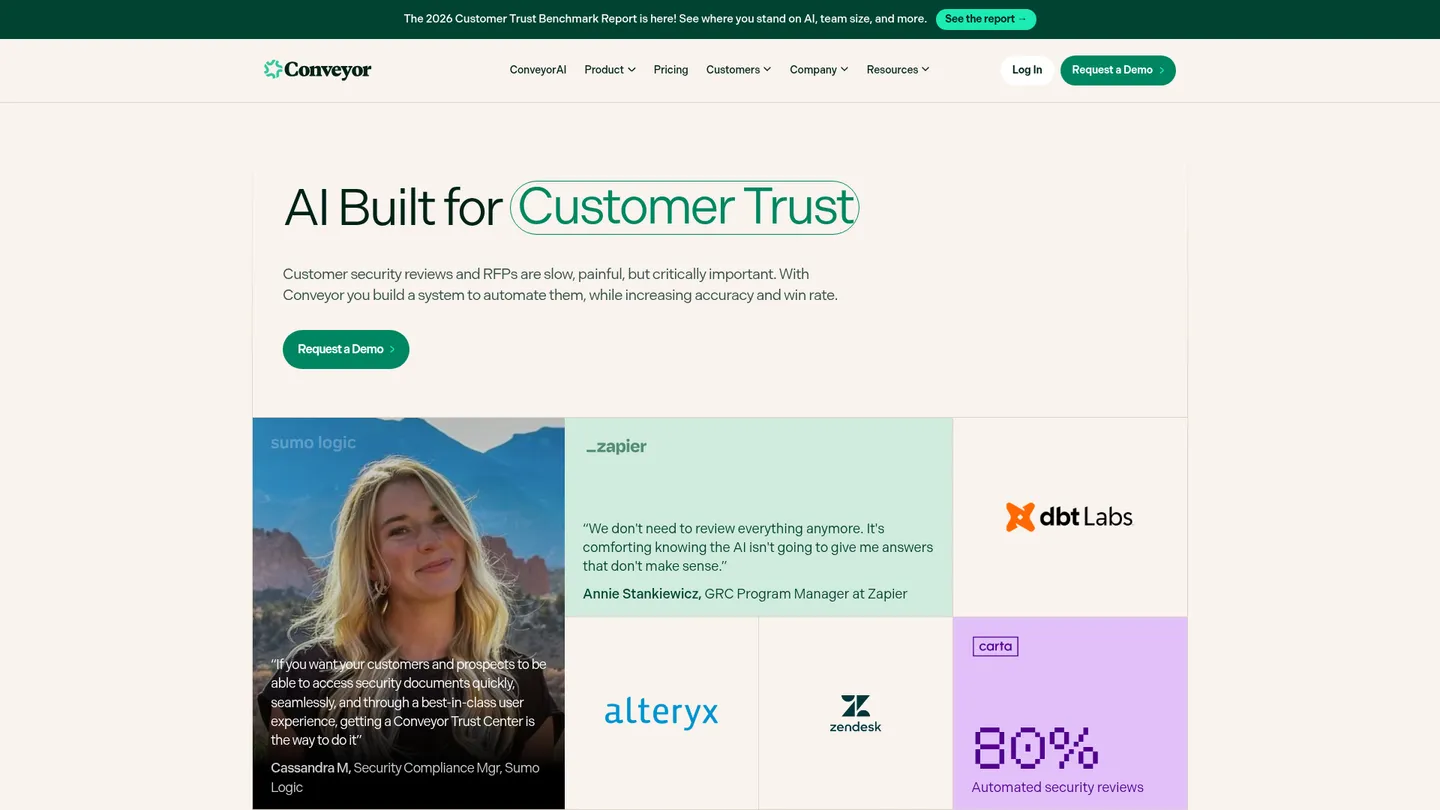
Founded in 2021 and headquartered in San Francisco, Conveyor has raised $40 million and serves hundreds of customers. Its AI platform automates customer security reviews, questionnaires, Trust Center access, and RFP responses for B2B vendors.
Conveyor is a customer-trust platform for companies that repeatedly answer security questionnaires, share compliance documents, and respond to RFPs. Teams build a controlled knowledge base from approved documents, prior answers, connected systems, and external sources. Conveyor’s AI agents ingest incoming requests, draft cited answers, route questions to subject-matter experts, and manage access approvals. Its Trust Center gives customers self-service access to security information, while its browser extension supports questionnaires submitted through third-party portals.
The product spans questionnaire automation, an agentic Trust Center, AI knowledge management, RFP response generation, sales triage, analytics, and workflow integrations. It connects with CRM, collaboration, ticketing, document, and AI tools, including Salesforce, Slack, Jira, Zendesk, and MCP. The platform is not a replacement for a compliance-management system or audit evidence repository. AI output quality depends on the accuracy, coverage, and permissions of the underlying knowledge sources, so human review remains important for sensitive responses.
Conveyor is aimed at security, privacy, compliance, sales engineering, proposal, and revenue teams at B2B software companies and other vendors facing frequent buyer reviews. Public customer examples include Atlassian, Carta, dbt Labs, Zendesk, and Zapier, and the company says it serves hundreds of customers. A free tier provides a basic Trust Center, while the automation platform is custom-priced by usage with unlimited seats, volume discounts, integrations, analytics, and enterprise controls. Conveyor offers a proof-of-concept so buyers can test their own content before purchase.
Key features
Questionnaire automation
Ingests security questionnaires, drafts cited answers from approved knowledge, and routes uncertain questions for review.
Agentic Trust Center
Provides an AI-powered customer-facing portal that answers buyer questions and shares approved security documents.
AI knowledge management
Connects documents, prior answers, websites, and business systems while identifying gaps and keeping content current.
RFP response automation
Drafts sales-ready RFP responses from briefs, deal documents, win themes, and cross-functional company content.
Workflow triage
Detects incoming security requests, assigns work, communicates with requestors, and automates approval steps.
Portal automation
Uses a browser extension to help complete questionnaires inside third-party vendor-security portals.
Trust analytics
Reports on questionnaire performance, Trust Center engagement, customer requests, and security-review impact.
Conveyor pricing
The current pricing page offers a free Trust Center tier and a custom paid platform priced on usage rather than access. Paid plans have no per-user fees or integration charges and include volume discounts. A prior company blog cited a $4,800 Professional plan, but current pricing uses a different model.
| Plan | Price | What's included |
|---|---|---|
| Free | FreeFree Trust Center tier. | Simple Trust Center, secure document sharing, up to 15 documents and 15 knowledge-base Q&As; no questionnaire automation or integrations |
| Custom | CustomPaid platform priced on usage. | Full Conveyor Platform, unlimited users and seats, questionnaire automation, AI agents, integrations, analytics, enterprise settings, volume discounts, and dedicated support |
Free trial: The vendor offers a free proof-of-concept and lets prospects test the platform with their own content before signing.
Pros & cons
Pros
- Combines Trust Center sharing, questionnaire automation, RFP responses, and knowledge management in one customer-trust workflow.
- Cites source content and learns from approved or edited answers instead of relying only on a static answer bank.
- Connects to sales, collaboration, document, ticketing, and AI tools including Salesforce, Slack, Jira, and MCP.
- Customer cases describe substantial reductions in questionnaire effort, including Zapier’s 75% time reduction and 3x capacity increase.
Cons
- Paid pricing is custom and usage-based rather than a published dollar price for the full platform.
- The free tier excludes questionnaire automation and integrations, so serious automation requires a paid plan.
- AI answers still require review for company-specific nuance, especially where approved source content is incomplete.
- Browser-based third-party portal workflows and complex enterprise processes may require setup and configuration.
Who is Conveyor best for?
- Security and compliance teams answering high volumes of customer questionnaires with a small staff.
- B2B software vendors that need a self-service Trust Center for security and compliance documents.
- Revenue teams combining security-review automation with RFP response and sales workflows.
- Organizations with established, approved security content that can serve as a reliable AI knowledge base.
Use cases
Integrations
Notable customers
Frequently asked questions
How much does Conveyor cost?
+
Conveyor has a free Trust Center tier. Its paid platform is custom-priced on usage, with no per-user fees, and the current pricing page does not publish a paid starting dollar amount. A prior company blog cited $4,800 for an earlier Professional plan, but current pricing uses a different model.
How does Conveyor work and how long does implementation take?
+
Teams connect approved documents, prior answers, knowledge bases, and external sources, then upload questionnaires or route requests from connected systems. Conveyor drafts cited answers, flags items for people, and can automate approvals and triage. A customer case study says Zapier went from kickoff to public launch in under 30 days, but timelines vary by workflow.
How does Conveyor compare with Vanta?
+
Conveyor focuses on customer security reviews, while Vanta is primarily a compliance-management and audit-readiness platform. Conveyor provides questionnaire automation, a customer-facing Trust Center, knowledge management, and RFP responses rather than running a full internal compliance program.
What integrations does Conveyor support?
+
Named connections include Salesforce, HubSpot, Slack, Microsoft Teams, DocuSign, Ironclad, Google Drive, Notion, Confluence, Jira, and Zendesk. Conveyor also lists MCP, public APIs, and a browser extension for third-party portals. Exact availability can depend on the plan and workflow.
Who is Conveyor for?
+
Conveyor is designed for B2B software and other vendors whose security, privacy, sales, or proposal teams answer recurring customer reviews. Public customer examples include Atlassian, Carta, dbt Labs, Hootsuite, Lucid, Qualtrics, Sprout Social, Sumo Logic, Temporal, Zendesk, and Zapier.
Is Conveyor secure and accurate enough for security reviews?
+
The vendor says its controls include SOC 2 Type II, encryption at rest and in transit, access controls, vulnerability scans, and alignment with ISO 27001 and NIST. Its AI cites source content and supports human review, but buyers should validate the current security package and test accuracy against their own approved materials.
Sources
Facts and pricing verified on October 19, 2026. Vendors change pricing often, so confirm with Conveyor before buying. How we research